
The Piece Most People Miss About Rosh Hashana
Most people approach Rosh Hashana as a frightening “day of judgment,” something to get through.
Rabbi Yaakov Avraham Shepherd teaches something different: Rosh Hashana and Yom Kippur aren’t only about judgment. They’re a process of separation turning into reunion, a process Kabbalah calls the Nesirah.
What the Nesirah Actually Is
The Arizal explains the Ten Days of Repentance through the secret of the creation of Adam and Eve.
The Torah describes them as created “back to back” (achor b’achor), one body, two faces, facing away from each other.
Hashem cast a sleep upon Adam, took from his side, built a separate form from it, and then turned the two of them to face each other, panim b’panim.
This isn’t just a Genesis story.
Rav Shepherd teaches that the entire process of the Ten Days of Repentance, from Rosh Hashana to Yom Kippur, is that exact same process, playing out on a cosmic scale: a process of Nesirah, carrying within it a quality of “sleep,” and within that, the sounding of the shofar, whose role is to awaken us from that very sleep.
Day by Day: The Ascent From Keter to Malchus
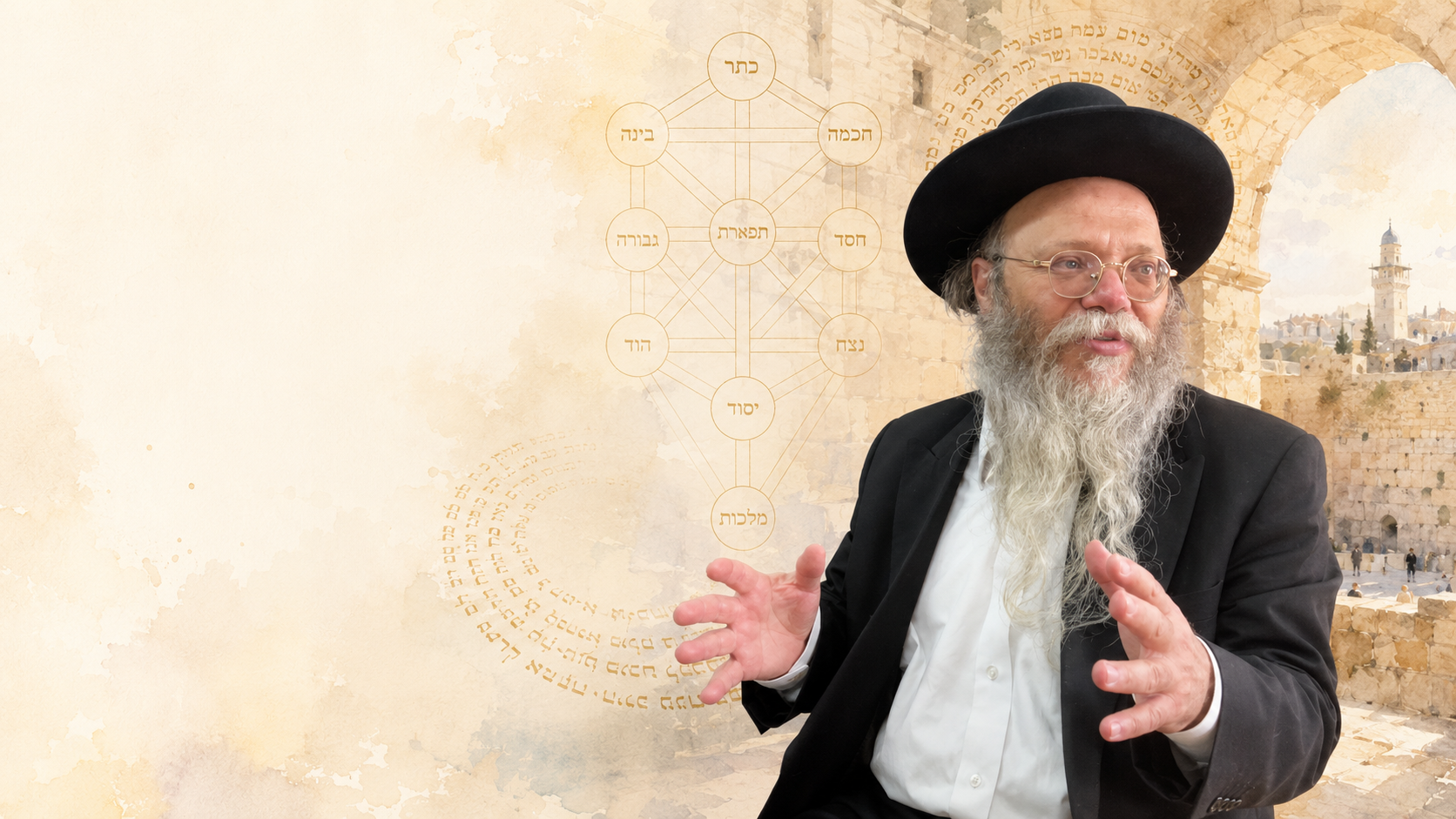
Here Rav Shepherd gives a precise and surprising key: each of these ten days corresponds to one of the ten Sefiros.
The first day of Rosh Hashana is Keter. The second, Chochmah. And so on, day after day, until Yom Kippur, which is Malchus, “what is called the return to face-to-face.”
The turn from “back to back” to “face to face” happens on Yom Kippur itself.
This is not something you will find on Wikipedia.
It is a precise, day-by-day map that places the Ten Days of Repentance onto the ten Sefiros, turning each of the ten days into a specific inner task, not vague self-improvement, but the correction of that exact day’s spiritual rung.
Why Mercy Comes Before Judgment
Before judgment arrives, Elul arrives first, the month of the Thirteen Attributes of Mercy.
Rav Shepherd explains it with a parable:
“You’re standing before a trial. And before you walk in, the judge comes to you and says: it will be fine, don’t worry, I love you, we’ve known each other a long time.”
This isn’t meant to erase the awe of the Day of Judgment, it’s a recognition that Hashem arranged it so that we would first know there is mercy, and only afterward comes judgment.
The Shofar: More Than an Alarm, Renewing the Mochin
Beyond awakening us from the sleep, the shofar carries a further role Rav Shepherd teaches: the renewal of the Mochin, the spiritual sustenance that feeds the higher worlds.
The shofar sweetens all the Mochin that existed before in the spiritual worlds, and opens for us the chance to receive levels of spirituality we have never experienced before.
What This Means for Us, Practically
The Nesirah process teaches that the distance between us and Hashem after sin isn’t a distance of disconnection, it’s a “back to back” distance, and it has a clear direction: toward face-to-face.
Each of the Ten Days of Repentance is a chance to correct one rung along that path.
At Yeshivat HaMekubalim Nefesh HaChaim, we study these secrets in depth, not as theory, but as a real working tool for the Days of Awe.
Practice that aligns your heart toward the Days of Awe, day by day: the app.jmeditate.com
To go deeper into Rav Shepherd’s teachings on the Ten Days of Repentance: King David Kabbalah
Source: shiur by Rav Yaakov Avraham Shepherd on Elul and preparation for Rosh Hashana (Yeshivat Kever David).