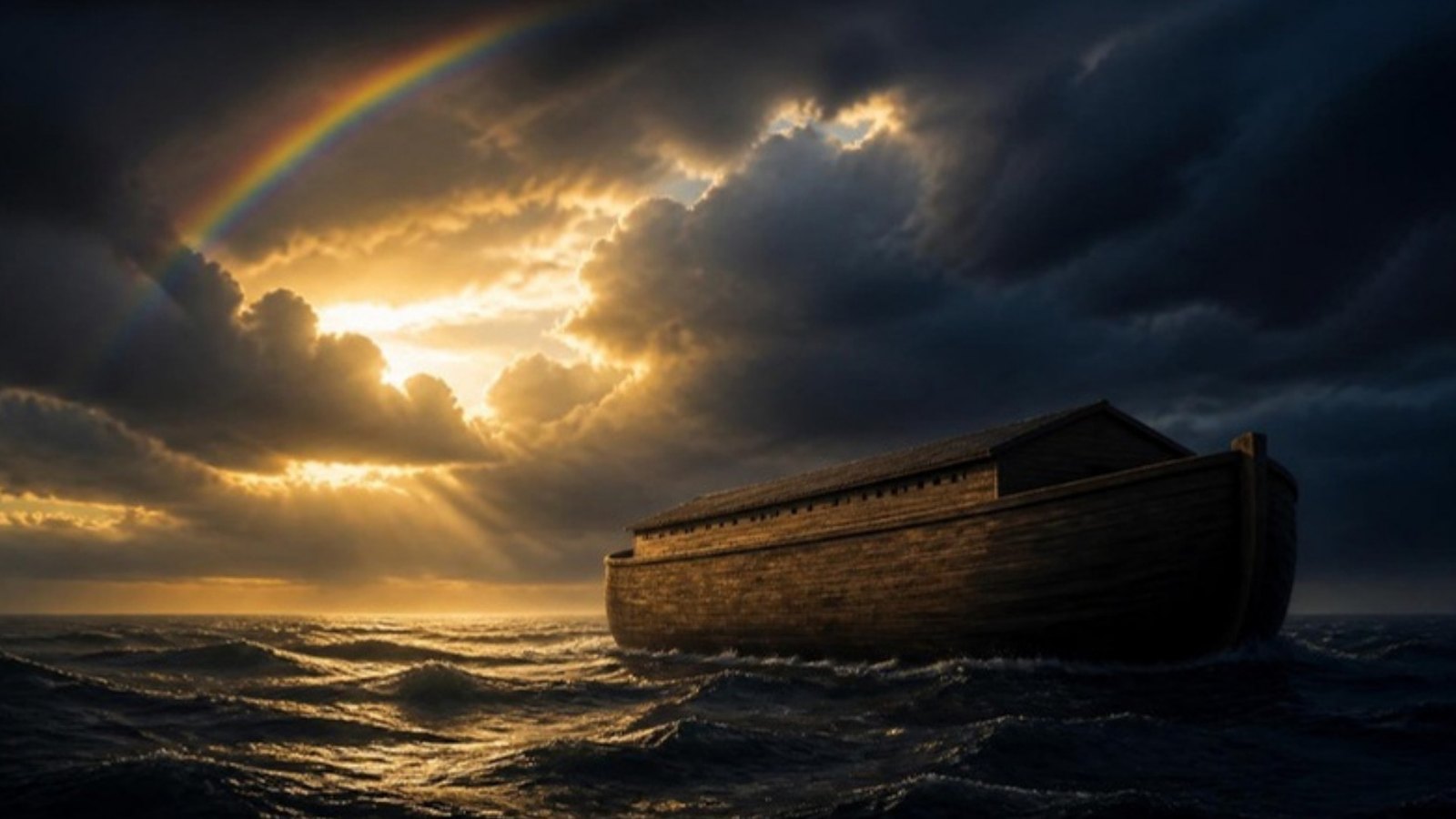
This week we take nine verses from the Torah portion of Noach, from the decree of the flood to the sign of the covenant in the cloud. On these nine verses the Meirat Einayim of Rabbi Yitzchak of Acco brings amazing kabbalistic insights into the commentary of the Ramban: where the Ramban hints and does not say, the Meirat Einayim opens the hint. The earth that suffers, the covenant, the "I" that speaks, and the bow itself are all the Atarah (the sefirah of Malchus), the Shechinah. From each of them Rabbi Shepherd draws a lesson for our own lives.
And God said to Noach: The end of all flesh has come before Me, for the earth is filled with violence through them, and behold, I will destroy them with the earth.
The Ramban begins with the two plain readings of "I will destroy them with the earth," and then with a hidden meaning behind them.
The Ramban
From the earth, or with the earth
The Ramban begins with the plain readings. The first is "from the earth," as in "when I go out from the city" (Exodus 9:29) and "he was sick from his feet" (I Kings 15:23). The second is "with the earth": even three handbreadths of the depth of the plough dissolved. Here the Ramban brings the words of Rashi, from Genesis Rabbah (Rashi on Genesis 6:13; Genesis Rabbah 31:7). Then the Ramban connects what Ibn Ezra explained, that the verb should be read twice: I will destroy them, and I will destroy the earth.
By way of truth
But the Ramban does not stay with the plain meaning. He says there is also a way of truth, the hidden way of the Kabbalah, and in this way the word "the earth" is read like the pair we know from the first verse of the Torah:
By way of truth it is like "the heavens and the earth" (Genesis 1:1). The Ramban goes on to say that the earth itself will be in destruction, and in the destruction of the earth they are destroyed, and so they are destroyed in the World to Come, in the way of "and He was grieved to His heart" (Genesis 6:6). How can the earth suffer for what people did? To this the Sages hinted in a parable:
Like the son of a master who had a wet nurse: whenever he misbehaved, his wet nurse was punished. So the earth is like the nurse, who is hurt when the child misbehaves. But the Ramban only hints, and does not say who the wet nurse is. The Meirat Einayim says who she is.
Meirat Einayim · Rabbi Yitzchak of Acco
The wet nurse is the Atarah (the sefirah of Malchus)
Rabbi Yitzchak of Acco opens the hint, beginning with the verse the Ramban pointed to, "the heavens and the earth." In the Kabbalah, he explains, the heavens allude to Tiferet (Beauty) and the earth to the Atarah (the sefirah of Malchus). The earth in our verse is therefore the Atarah, which he also calls the Land of the Living. And so the wet nurse of the parable is the same:
"הַמְּנִיקָה" רוֹמֶזֶת לַעֲטָרָה
(Meirat Einayim on Genesis 6:13, Rabbi Yitzchak of Acco)
The vowels were added by the editor; they have not been checked and do not appear in the source. If you have a correction, we would be glad to receive it at join.mekobalim.org.
"The wet nurse" alludes to the Atarah. He adds that he already explained this earlier, in his commentary on Genesis. Put together: the earth that suffers in the flood, and the wet nurse who is punished for the child, are one and the same, the Atarah, which is also called the Shechinah (the Divine Presence). What does this mean for us?
So Rabbi Shepherd draws the lesson that we should not dismiss the things we do or see as insignificant.
Rabbi Shepherd
Part One · Genesis 6:13
Rabbi Shepherd's commentary
Rabbi Shepherd explains that the Midrash the Ramban brings, about the wet nurse of the prince, the son of the king, is speaking of the Shechinah (the Divine Presence). As the Meirat Einayim says, it is the Atarah, which is the ancient way of saying Malchus (Kingship), which is the Shechinah. And from here, Rabbi Shepherd adds, we see that when we do wrong things in this world, it affects the spiritual worlds, and specifically the Shechinah, who nurtures us. So Rabbi Shepherd draws the lesson that we should not dismiss the things we do or see as insignificant. When something happens, we should quickly repent and try to correct the wrong act as soon as we can, because the same way the negative affects the spiritual realms, and specifically the Shechinah, who suffers because of our wrongdoings, all the more so in the good measure: when we repent and do good deeds, we repair the Shechinah and bring blessings to the world.
And I, behold, I bring the flood of waters upon the earth, to destroy all flesh in which there is the breath of life from under the heavens; all that is on the earth shall perish.
The Ramban asks a question on this reading, and then reads the same word "I" in a deeper way.
The Ramban
How did He agree with them
The Ramban wonders: how did He agree with the angels, when He left a great remnant in Noach and his sons and every living thing, to multiply their seed like the sand? Perhaps it was an agreement with their view for the time when He would have no compassion on them. That is as far as the plain meaning takes him.
"And I" by way of truth
Then he gives the hidden meaning, and the whole of it rests on the first word, "And I." The Ramban sets beside it three other verses where the same word opens the sentence. Va'ani (and I) is like "and I also will chastise you" (Leviticus 26:28), and like "I, behold, My covenant is with you" (Genesis 17:4), and "and I, this is My covenant" (Isaiah 59:21). Read with those verses, our verse says:
The verse says: I also, My hand will be on them, because they destroyed the earth.
Two of those three verses speak of a covenant, and he follows that thread forward: this is why He said afterwards, "This is the sign of the covenant which I give" (Genesis 9:12). The Ramban closes with the verse "He wounds, and His hands heal" (Job 5:18), and the one who understands will understand. He does not say who this "I" is. The Meirat Einayim does.
Meirat Einayim · Rabbi Yitzchak of Acco
Every "I" here is the Atarah (the sefirah of Malchus)
Rabbi Yitzchak of Acco reminds us of what he wrote in his Introduction: in most places the word Ani (I) alludes to the Atarah (the sefirah of Malchus). Hu (He) alludes to Keter (the Supernal Crown); Attah (You) to Tiferet (Beauty); and Ani (I) to the Atarah. This is the meaning of what we say, "I and He, save us" (Mishnah Sukkah 4:5), a hint to the unification from below to above. With that key in hand he reads the Ramban's three verses, and ours:
(Meirat Einayim on Genesis 6:17, Rabbi Yitzchak of Acco; his "HaRav z"l" is the Ramban)
The vowels were added by the editor; they have not been checked and do not appear in the source. If you have a correction, we would be glad to receive it at join.mekobalim.org.
Every "I" that the Ramban mentioned here alludes to the Atarah, which is called Zot (this) and Brit (covenant). Both of those names are the very words of the verse the Ramban pointed to, "This is the sign of the covenant" (Genesis 9:12). And the Ramban's closing verse, "And His hands heal" (Job 5:18), he reads as the attribute of judgment, the hard and the soft. The hard and the soft are both in it.
There is a state of the Malchus as judgment, and there is a state of the Malchus when it is sweetened.
Rabbi Shepherd
Part Two · Genesis 6:17
Rabbi Shepherd's commentary
Rabbi Shepherd explains that the Ramban mentions here the concept of Ani (I), which according to the Meirat Einayim is the Atarah, which is the Malchus (Kingship). The explanation, he says, is that the Malchus has different states. There is a state of the Malchus as judgment, and there is a state of the Malchus when it is sweetened. So the Malchus that was in the state of judgment was judging, and then, after the judgment, there is the rainbow, which is connected with the concept of the Tzaddik (the Righteous One), the Yesod (Foundation), that sweetens the Malchus, and then the Malchus reveals its mercy.
And I will establish My covenant with you, and you shall come into the ark, you and your sons and your wife and your sons' wives with you.
Here Ibn Ezra speaks first, and at length. Then the Ramban gives his own plain reading and his hidden one.
The Ramban
A hint to the bow
Ibn Ezra explains: the covenant is a sign that Hashem swore to Noach that he and his sons would not die in the flood, even though the oath was not written earlier; "I will establish" means "I will fulfill My oath"; and, in his own words:
And what seems likely to me is that this covenant is a hint to the bow.
The bow is the rainbow at the end of the portion (Genesis 9:12). A covenant, Ibn Ezra continues, is an agreement, a thing that two parties chose. "All these are his words," says the Ramban, and he prefers a plainer reading: when the flood comes a covenant will stand with you, that you and your house and two of all flesh come into the ark and live, for a covenant is Hashem's word when He decrees without condition and fulfills it (Ramban on Genesis 6:18).
The covenant is from the world
Having given the plain reading, the Ramban turns again to the way of truth, as he did on 6:13 and 6:17. Here the hidden meaning is in the word "covenant" itself, and where it comes from:
By way of truth, the covenant is me'olam (from the world), and the word is derived from "In the beginning God created" (Genesis 1:1).
So "My covenant" is like "My creation," and the word is in the construct form, joined to the worlds that were before us. He commands that it stand and be with the righteous one. So too "and I, behold, I establish My covenant with you" (Genesis 9:9), and "My covenant was with him" (Malachi 2:5). The Ramban has given two words, covenant and world, and has not said what they stand for. The Meirat Einayim does.
Meirat Einayim · Rabbi Yitzchak of Acco
Brit and Olam
Rabbi Yitzchak of Acco reads the Ramban's words one by one, first "the covenant," then "from the world":
(Meirat Einayim on Genesis 6:18, Rabbi Yitzchak of Acco)
The vowels were added by the editor; they have not been checked and do not appear in the source. If you have a correction, we would be glad to receive it at join.mekobalim.org.
The covenant is the Atarah (the sefirah of Malchus); "from the world" alludes to Tiferet (Beauty), which is called Olam (world), because it sustains the extremities. So Tiferet is the essence of the world, and the covenant comes from it, "for from man was this one taken" (Genesis 2:23). Brit olam (a covenant of the world) is a construct, joined to Tiferet and to Yesod (Foundation), for Tiferet is Olam and Yesod is "the Life of the Worlds." This is why the Ramban then says "with the righteous one," the Tzaddik (the Righteous One), foundation of the world. And "and I," as before, alludes to the Atarah.
So the one phrase, a covenant from the world, holds both the Atarah and Tiferet.
Part Three · Genesis 6:18
Rabbi Shepherd's commentary
Rabbi Shepherd explains that the Meirat Einayim says here that the Brit (covenant) is connected with the Atarah, which is the Malchus (Kingship). But then the Meirat Einayim says that in Brit me'olam (a covenant from the world), the Olam (world) relates to the Tiferet. So the Brit me'olam, Rabbi Shepherd adds, is the connection between the Malchus and the Tiferet, the masculine and the feminine together. And this is also the concept of the Keshet be'anan (the bow in the cloud): the cloud is the feminine aspect, and the rainbow is the masculine aspect that connects to it.
Of the fowl after its kind, and of the cattle after its kind, of every creeping thing of the ground after its kind, two of every sort shall come to you, to keep them alive.
The Ramban reads the two verses together. On the first he counts, and on the second he explains how the animals came.
The Ramban
The little held the much
On 6:19 the Ramban counts. The beasts are very many, and some are very large, elephants, re'emim (wild oxen) and others. The creeping things are very many. Of the birds there are kinds without number: the Sages said there are a hundred and twenty kinds of unclean birds in the east, all of the kind ayah (a bird of prey) (Chullin 63b), and the clean birds have no number. Noach had to bring from all of them, so that they would breed their like, and gather food for all of them for a whole year. This ark could not hold them, nor ten like it. So how did they fit? The Ramban answers in one line:
אֲבָל הוּא נֵס הֶחֱזִיק מוּעָט אֶת הַמְּרֻבֶּה
(Ramban on Genesis 6:19)
But it was a miracle: the little held the much.
That answer raises the next question. If a miracle was needed in any case, why build the ark so large?
Why not build it small
If you say he should have built it small and relied on this miracle, Hashem saw fit to make it large so that the people of his generation would see it, wonder at it, tell of it, and speak about the flood and the gathering of the cattle, the beasts and the birds into it; perhaps they would repent. That is the first reason. And further, they made it large to lessen the miracle, and here the Ramban states a rule that goes far beyond the ark:
For such is the way in all the miracles of the Torah or the Prophets: to do what is in the hand of man to do, and the rest is in the hands of Heaven.
The Ramban adds one more word on the size. Do not be persuaded, he says, that the three hundred cubits were cubits of Noach's own tall stature. If so, the people, the beasts and the birds of those generations were all tall, until the world was struck by the flood. And the cubits are the cubits of the Torah.
We need to make an effort and leave space for the miracle to take place.
Rabbi Shepherd
Part Four · Genesis 6:19, 6:20
Rabbi Shepherd's commentary
Rabbi Shepherd says that we see here a very important concept to know: Hashem, as it were, does not want to make a revealed miracle, for some reason. It is hard for some people to understand, he adds, but that is what the Torah is teaching us. As long as it is possible to hide the miracle within nature, Hashem chooses to do so. And when there is a revelation, it must be that there is a purpose for it, that people will learn a lesson from it. Rabbi Shepherd draws from this a lesson for us. When we do something in the physical, and we think to ourselves, how can that small act be enough, how can it satisfy the needs that we have, we see here that it does not need to make sense. It does not need to satisfy the needs in a calculation. We need to make an effort and leave space for the miracle to take place. And because we made the effort, it will be a hidden miracle and not a revealed miracle. That, Rabbi Shepherd says, is what Hashem wants, and that is what we learn here.
The Ramban
They come of themselves
Now the Ramban goes back to the second verse, 6:20, and adds to the point that the animals came of their own accord. On "two of every sort shall come to you":
He informed him that of themselves they would come before him two by two, and he would not need to hunt them in the mountains and the islands. He would bring them into the ark afterwards.
The Ramban then sets this beside a later command, where the wording is different. Later He commanded him to take seven and seven of the clean beasts (Genesis 7:2), and of these He did not say that they would come to him, but that he would take them. Those coming to be saved and to keep seed alive come of themselves, but those meant for burnt offerings were not decreed to come of themselves to be slaughtered; Noach took them, for the command of seven and seven was so that he could bring an offering from them.
The clean
That later command speaks of "the clean" beasts, and the word needs an explanation. The Ramban gives it:
The meaning of "the clean": the Holy One, blessed be He, explained to him the signs of purity, and Scripture speaks briefly, "the clean," according to the Torah. Rashi adds: that which would in the future be clean for Israel, which teaches that Noach learned Torah (Rashi on Genesis 7:2). The Ramban continues: from here, the offerings of the sons of Noach were valid only from a clean beast and a clean bird, as it says of Hevel, "of the firstborn of his flock" (Genesis 4:4); but all the clean kinds are valid for them, as Noach did after the flood (Genesis 8:20); to Israel He added that all their offerings be from the cattle, the sheep, the turtledoves and the young pigeons.
Part Four · Genesis 6:19, 6:20
Rabbi Shepherd's commentary
On that one word, "clean," Rabbi Shepherd adds a note on the translation: the Hebrew word tahor does not mean "clean." It means "pure," and kosher.
Hashem informed him that with the attribute of mercy He would save him and his house, and give life from them to seed for generations.
So the Name itself tells Noach how he is being saved: with mercy.
The offering that keeps the world
That mercy, the Ramban says, is the meaning of "to keep seed alive upon the face of all the earth" (Genesis 7:3). At first He had said only "to keep them alive with you" (Genesis 6:19). Now, with the attribute of mercy, He hinted to him about the offering, to let him know that He would turn to his offering:
And by the merit of his offering He would sustain the world, and it would never again be cut off by the waters of the flood.
This is why the special Name is mentioned here, for in all matters of the offerings Scripture does not mention Elokim (God, the Name of judgment), as the Ramban promises to explain when he reaches Leviticus. The Ramban has named the attribute, mercy. Rabbi Yitzchak of Acco names the sefirah behind it, and then raises a question of his own.
Meirat Einayim · Rabbi Yitzchak of Acco
Tiferet, which is mercy
Rabbi Yitzchak of Acco writes that "and Hashem said to Noach" is Tiferet (Beauty), which is mercy. A teacher whose name is printed only in code asked: speech (dibbur) alludes to Tiferet and saying (amirah) to the Atarah (the sefirah of Malchus), so why does the verse say vayomer (and He said)? The Name is mercy, but the verb belongs to the Atarah. Rabbi Yitzchak's own answer:
(Meirat Einayim on Genesis 7:1, Rabbi Yitzchak of Acco)
The vowels were added by the editor; they have not been checked and do not appear in the source. If you have a correction, we would be glad to receive it at join.mekobalim.org.
He expressed mercy in the language of judgment, to hint that the righteous turn the attribute of judgment into mercy.
That time, he explains, was a time of judgment and vengeance. Although the Ramban gave a sufficient reason, this too is good. On the offerings he adds: the essential intention of the offerings is to the Unique Name, as the verse says, "save to Hashem alone" (Exodus 22:19), and as the Sages taught.
Two Names, then, and two attributes, judgment and mercy.
Part Five · Genesis 7:1
Rabbi Shepherd's commentary
Rabbi Shepherd explains that we know from many different places, and this is one of them, that the name Elokim (God) refers to the judgment aspect, and the four-letter Name, Havaya (Hashem), is the revelation of mercy.
06
Part Six
Come Into the Ark
Genesis 7:1
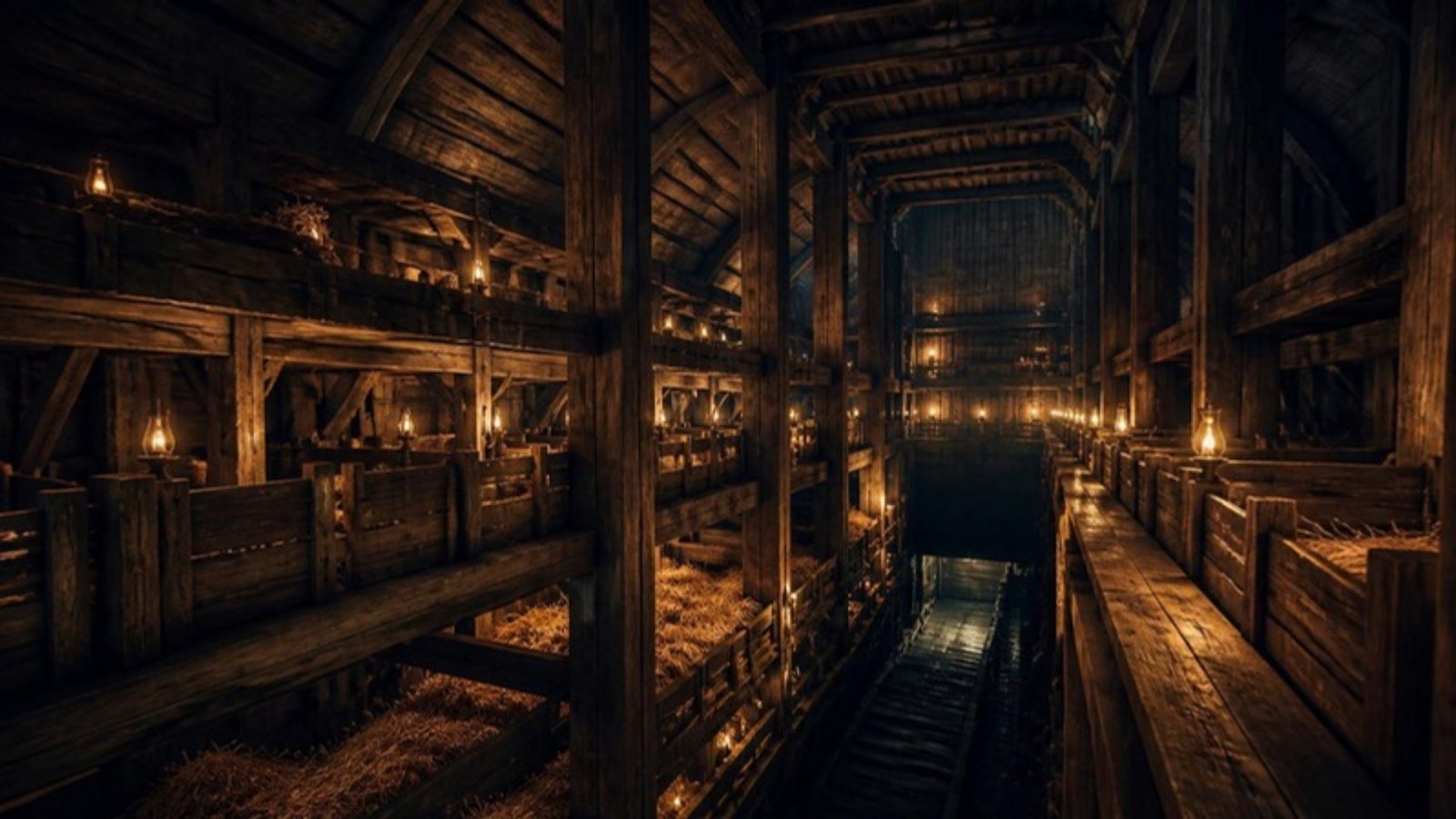
Illustration, generated image
The Ramban
By his merit alone
The Ramban continues on the same verse, now on the words "come, you and all your house." Noach made the ark many days before the flood. When the time of the flood drew near, on the tenth of the second month, He commanded him again to come with all his house into the ark, the same people He had named at first: you, your sons, your wife and your sons' wives (Genesis 6:18). And one thing more was told him now:
וְהוֹדִיעוֹ כִּי בִּזְכוּתוֹ לְבַדּוֹ יִנָּצְלוּ
(Ramban on Genesis 7:1)
And He informed him that by his merit alone they would be saved.
How does the Ramban know this? For He did not say "you (in the plural) have I seen righteous before Me." He commanded him to take seven and seven of the clean animals and birds, and told him the day of the flood, on which he was to come into the ark. And so he did: "on that very day Noach came" (Genesis 7:13). That is the meaning of "because of the waters of the flood" (Genesis 7:7). On that last verse the Ramban stops to argue with a Midrash.
The Ramban and Rashi's "little faith"
Noach was lacking in faith; had the waters not reached his ankles he would not have entered (Genesis Rabbah 32:6). Rashi adds that Noach too was among those of little faith, and did not enter the ark until the waters pushed him (Rashi on Genesis 7:7). The Ramban objects: if so, it should have said that he did not enter until the waters grew strong and covered the face of the whole earth and he saw that he would drown.
Rashi's reading, that Noach waited until the water pushed him, carries a lesson.
Noach did not go into the ark until the water was pushing him in.
Rabbi Shepherd
Part Six · Genesis 7:1
Rabbi Shepherd's commentary
Rabbi Shepherd says this is a very big moral lesson for us. Many times we know better than what we are doing, and we have this doubt, maybe it is not the reason, maybe it is not true, until it becomes so obvious that we cannot ignore it anymore. Noach did not go into the ark until the water was pushing him in. It does not make sense, Rabbi Shepherd says, but we see here in the Torah that this is the nature of human beings. With the help of Hashem, he adds, we will learn this lesson, and we will take the first hint, the first message of Hashem to us, and not wait until we have no choice and our arm is twisted behind our back.
Of the clean beasts, and of the beasts that are not clean, and of the fowl, and of everything that creeps upon the ground,
The Ramban's comment on this verse takes in the verses around it, and he begins with the next verse.
The Ramban
Two came of themselves, Noach added six pairs
On "two and two they came to Noach" (Genesis 7:9), Rashi explains that all were equal in this number, for the least of any kind was two (Rashi on Genesis 7:9). Others said that "two" means pairs, that they came male and female together. In the Ramban's opinion it was so: from every kind two came of themselves, a male and a female, and Noach added six pairs from the clean ones:
For those who came to be saved came of themselves, and for those needed for an offering he labored in the commandment, for so he was told.
This is the same distinction the Ramban drew on 6:20: those saved come of themselves, and those for the offering are Noach's own labor.
On that very day, not before
The Ramban then goes through the verses that say Noach did as he was commanded, and what each one adds. "And Noach did according to all that Hashem commanded him" (Genesis 7:5) is, in Genesis Rabbah, that he prepared to bring in cattle, beast and bird (Genesis Rabbah 32:5), that is, the clean ones, which he himself went after and took to his house. The third "as God commanded Noach" (Genesis 7:9) tells that he did as he was commanded in entering the ark: Noach and his sons, his wife and his sons' wives came into the ark, and with him the two and two of the cattle, the birds and the creeping things that came to him, all of them entering because of the waters of the flood. Then Scripture returns to the month and the day the flood came and how it came, and says:
On that very day Noach came into the ark, and with him all living flesh, not before.
Not before.
Part Seven · Genesis 7:8
Rabbi Shepherd's commentary
As a continuation of the point he made just before, Rabbi Shepherd gives here an explanation that is a positive view of it. By waiting for the last moment, Noach also gave a chance for the last animals to join him. So on one hand there was a negative aspect to it, that he chose a faith that was not as great as was expected of him. But on the other hand, Rabbi Shepherd says, we see that this is what gave some species a chance to join the ark.
And He blotted out every living thing that was upon the face of the ground, from man to beast to creeping thing and to the fowl of the heavens, and they were blotted out from the earth; and only Noach was left, and those who were with him in the ark.
The Ramban reads the verse word by word: first "He blotted out," then "they were blotted out from the earth."
The Ramban
The bodies became water
The verses before ours already said "all flesh perished" (Genesis 7:21) and "all that was on the dry land died" (Genesis 7:22). Why does Scripture add "and He blotted out"? The Ramban answers:
שֶׁנִּמְחוּ הַגּוּפוֹת וַיִּהְיוּ לְמַיִם
(Ramban on Genesis 7:23)
That the bodies dissolved and became water, as in "and he shall blot them out into the bitter waters" (Numbers 5:23), for the waters of the flood were boiling, as the Sages said (Sanhedrin 108b).
But then, the fish
If the waters were boiling, the fish should have died too. Perhaps, the Ramban answers, it was as Genesis Rabbah says: "all that was on the dry land," and not the fish of the sea. And some say they too were included in the destruction, but fled to the ocean (Genesis Rabbah 32:11). Either way the fish were saved. Both views are possible, and the Ramban explains how each could be. The boiling waters of the flood may have mixed with the seas and heated only the upper waters, while the fish went down to the depths and lived there. Or, as the second view, the fish of the inland seas near the ocean fled there when they felt the heat of the water. And even if all of those died, most of the fish are in the ocean, where no flood came down, as it says "and the rain was upon the earth" (Genesis 7:12), and from there the fish returned after the flood, for all the seas go out from the sea and return there. He sums up:
On the whole, the fish were saved, for none of them entered the ark to keep seed alive. And in the covenant afterwards He names the bird, the cattle and every beast of the earth, "all that go out of the ark" (Genesis 9:10), and does not mention the fish of the sea.
The fish, then, are the one kind of life that was neither in the ark nor blotted out.
So Rabbi Shepherd draws the lesson that the Torah, which is the water, protects us from the flood, from the heat of this world.
Rabbi Shepherd
Part Eight · Genesis 7:23
Rabbi Shepherd's commentary
Rabbi Shepherd tells that we know, according to the Kabbalah, that the righteous are sometimes reincarnated within fish. And we also have a Midrash, he adds, where Rabbi Akiva says that the people of Israel are like fish, and the Torah is like the water. So Rabbi Shepherd draws the lesson that the Torah, which is the water, protects us from the flood, from the heat of this world.
The Ramban
Blotted out from the earth
The Ramban now returns to the verse, to its second verb. The verse says both "He blotted out" and "they were blotted out from the earth," and on this doubling the commentators explained: their memory was forgotten, since they left no seed. But what need is there to say so after all had died? Perhaps because of the birds and some of the creeping things, to say that no eggs of theirs remained on any tree or under the ground, for everything dissolved. It may also be that the verse means: He blotted out every living thing on the face of the ground, for from man to beast to creeping thing and to the bird of the heavens they were blotted out from the earth, and only Noach remained. Those are the plain readings. Our Sages expounded the same doubling:
"He blotted out," in this world; "and they were blotted out from the earth," from the World to Come. They made the earth mentioned here the Land of the Living, and the Ramban adds that he has already hinted at its secret. The Meirat Einayim already said on 6:13 that the Land of the Living is the Atarah (the sefirah of Malchus). Here he opens the hint again.
Meirat Einayim · Rabbi Yitzchak of Acco
The broker and the architect
Rabbi Yitzchak of Acco reads the Sages' words by way of truth: the letter vav (ו) of "and they were blotted out" alludes to Tiferet (Beauty) and "the earth" to the Atarah (the sefirah of Malchus), so together they hint to the two faces joined, which is the Atarah. "The Land of the Living" is the Atarah, and that is why it is called the World to Come, a secret hinted to our Sages. This is what was said above, that "heart" alludes to the Atarah. The heart is from the verse before the flood, "and He was grieved to His heart" (Genesis 6:6), the verse the Ramban already pointed to on 6:13. He closes with a tradition he received:
(Meirat Einayim on Genesis 7:23, Rabbi Yitzchak of Acco)
The vowels were added by the editor; they have not been checked and do not appear in the source. If you have a correction, we would be glad to receive it at join.mekobalim.org.
And I have received that this is the matter of the broker and the architect.
He says no more than that.
Part Eight · Genesis 7:23
Rabbi Shepherd's commentary
Rabbi Shepherd explains that the Meirat Einayim ends with a tradition he received, that this is the matter of the broker and the architect. Rabbi Shepherd brings the parable itself, so that the hint can be read. The parable is in Genesis Rabbah on the verse before the flood, "and He was grieved to His heart" (Genesis 6:6). Rabbi Berechiah said: like a prince who built a palace through an architect, and it did not please him; at whom should he be angry, if not the architect? Rabbi Asi said: like a prince who did business through a broker and lost; whom should he blame, if not the broker? (Genesis Rabbah 27:4). The Ramban writes on that verse that the Sages said a weighty thing in this parable, that it is a great secret not given to be written, and that whoever knows it will understand why that verse uses the Unique Name while the whole account of the flood uses the name Elokim (God) (Ramban on Genesis 6:6).
Rabbeinu Bachya explains why two parables were needed. From the architect alone one could err and think there are two powers, as if the architect were wiser than the king in his craft. That is not so, Heaven forbid; all is one, without separation. So the broker was added, for a broker has no power in the merchandise and no share in it. The architect is the broker and the broker is the architect. By way of Kabbalah he adds that the grief returns to "his heart," for the heart was the cause, "for it is the earth and the broker and the architect" (Rabbeinu Bachya on Genesis 6:6). This, Rabbi Shepherd says, is what the Meirat Einayim means: the heart and the earth are the Atarah, the Malchus (Kingship), the agent through which the King works, and it has no power of its own.
And God said: This is the sign of the covenant which I give between Me and you and every living creature that is with you, for everlasting generations.
The Ramban first asks whether the bow was new, then gives the plain meaning of the sign, and then the hidden secret of the Sages.
The Ramban
Was the bow created now
From the words "this is the sign of the covenant which I give" (Genesis 9:12) it would seem that there was no rainbow in the cloud from the days of creation, and that Hashem now created a new thing. Commentators gave a reason for the sign: the bow is not set with its feet upward, as if arrows were being shot from heaven, but the opposite, to show that no one is shooting at the earth from heaven. So too warriors turn their bow over in their hand when they call for peace. And this bow has no string on which to set arrows.
That is the reason of the commentators, who take the bow as something new. The Ramban does not accept that it was new.
The Greeks and the verse agree
The Ramban then writes that we must, whether we wish to or not, believe the words of the Greeks, that the rainbow comes naturally from the heat of the sun in moist air, for in a vessel of water facing the sun one sees the likeness of a rainbow. The language of the verse itself says so: "I have set My bow in the cloud" (Genesis 9:13), in the past tense, and not "I give." And there is a second proof in the word itself:
And the word "My bow" shows that He had the bow beforehand.
So the verse means: the bow that I set in the cloud from the day of creation will be, from this day on, a sign of covenant between Me and you. Whenever I see it, I will remember that there is a covenant of peace between Me and you. Any visible thing placed before two parties to remind them of what they agreed is called a sign, like the heap of stones and the pillar of Yaakov and Lavan (Genesis 31:52), and like the seven ewes of Avraham (Genesis 21:30), and every agreement is called a covenant. The same is true of circumcision.
That is the plain meaning, and the Ramban has given it in full. But he does not stop there.
The hidden secret of the Sages
But, the Ramban says, our Sages have a hidden secret in this passage. In Genesis Rabbah they read kashti (My bow) as something compared to Me, and answer: like the straw to the fruit. On "when I bring a cloud" (Genesis 9:14) they give the parable of a man holding boiling flour who wanted to cast it on his son and cast it on his servant. And on "between God and every living creature" (Genesis 9:16) they say: "between God" is the attribute of judgment above, and "every living creature on the earth" is the attribute of judgment below. The upper one is hard and the lower one is soft (Genesis Rabbah 35:3). To these three sayings of the Midrash the Ramban adds a fourth, from the Talmud, said of one who gazes at the rainbow: whoever does not care for the honor of his Maker, it would have been better had he not come into the world (Chagigah 16a). If you merit to understand their words, he writes, you will know that this is the explanation of the verse:
My bow, which is the attribute of judgment, set in the cloud at the time of judgment, shall be a sign of covenant.
Here the Ramban says it plainly: the bow is the attribute of judgment, and that very judgment, set in the cloud, is what becomes the sign of the covenant. He then goes on to the next verses.
A remembrance of mercy
"When I bring a cloud over the earth" (Genesis 9:14) means that Hashem will not make His face shine upon the earth because of the sins of its inhabitants, and My attribute of judgment will be seen in the cloud:
And I will remember the covenant with a remembrance of mercy, and I will have compassion on the little ones who are on the earth.
This sign and this covenant are like the sign of circumcision and its covenant. Rashi wrote "between the attribute of judgment above and you" (Rashi on Genesis 9:16); the Ramban says that this is not what the Sages intended.
The Ramban has left two things for the reader to open: why we believe the Greeks here, and what the remembering is. Rabbi Yitzchak of Acco opens both.
Meirat Einayim · Rabbi Yitzchak of Acco
Why we believe the Greeks here
Rabbi Yitzchak of Acco explains the Ramban's phrase about the Greeks: although it is forbidden to study Greek wisdom, in this matter we believe them, because the verse says "I have set" and not "I will set" (Genesis 9:13). Greek wisdom is not the wisdom of nature (Rabbi Avner in the name of the Ramban). Our Sages knew nature better than the Greeks, and it came to the nations only from Israel. The wisdom the Sages warned against is one the Greeks invented from their own hearts, which draws a person to throw off the yoke of Torah.
Remembering is mercy
Next he comes to the Ramban's words "whenever I see it I will remember," and reads the word remembering:
(Meirat Einayim on Genesis 9:12, Rabbi Yitzchak of Acco)
The vowels were added by the editor; they have not been checked and do not appear in the source. If you have a correction, we would be glad to receive it at join.mekobalim.org.
Wherever there is remembering, it is mercy, the flow of peace, which is the Tzaddik (the Righteous One), to the covenant, which is the Atarah (the sefirah of Malchus).
So the remembering the Ramban spoke of is a flow from the Tzaddik to the Atarah, from the Righteous One to the covenant.
The bow that includes every color
Then he comes to the Midrash, and reads it the same way. "Kashti (My bow), something compared to Me" (Genesis Rabbah 35:3) is Tiferet (Beauty) speaking of the Atarah, which is the power of the bow seen in the cloud. Because the Atarah is comprised of everything and is the culmination of every color, and in the bow something like colors is seen, the Sages said it is forbidden to gaze at the rainbow, out of regard for the honor of one's Maker. So as soon as one sees it he says the blessing and does not keep looking. "Like the straw to the fruit" (Genesis Rabbah 35:3) he reads as including and surrounding, not as likeness: as the straw holds the grain and the peel surrounds the fruit,
(Meirat Einayim on Genesis 9:12, Rabbi Yitzchak of Acco)
The vowels were added by the editor; they have not been checked and do not appear in the source. If you have a correction, we would be glad to receive it at join.mekobalim.org.
so the bow, which is the Atarah, includes everything, for everything is in her and she is in the whole.
That is his reading of the Sages. He then adds a thought of his own.
His own reading of the sign
His thought is this: a rainbow seen in the strength of pouring rains is a sign to rebellious people that they need not fear a flood, and a rainbow seen after a hard drought, at the start of the rain, is a sign to all that Hashem is filled with mercy for the earth, to pour His blessing on it. On the parable of the boiling flour: even if people sin and bring it upon themselves, the sight of the bow in the cloud causes mercy, and what should have come down on them is poured onto the deserts and places where it harms no one. So the Sages said of the rains allotted on Rosh Hashanah: if people merit, they fall on fields and vineyards; if not, into seas, rivers and deserts, where the sinner gets no benefit.
Torah · From Rabbi Shepherd's talk on the Zohar
The righteous of his generation
Illustration, generated image
Noach did not pray for his generation, and yet he was the righteous man of his generation, and the righteous man of a generation is able to help everybody. All the souls are connected like the leaves of one tree, and each person, in his own domain, can lift himself and everyone around him.
From Rabbi Shepherd's talk on the Zohar
One tree, many leaves
Rabbi Shepherd explains that a person who works on himself can do it not only for himself; he can also help others, because we know that all the souls are connected. It is like one big tree, and all of humanity is like the leaves of the tree, but it is all connected. (Rabbi Yaakov Avraham Shepherd, Zohar talk on Noach, YouTube EQ9D3xDHdjg, 7:17 to 7:34, seconds 437 to 454)
It is like one big tree, and all of humanity is like the leaves of the tree, but it is all connected.
Rabbi Shepherd
The righteous of his generation
And that, Rabbi Shepherd says, is what it comes back to with Noach. Noach was the righteous person of his generation, and the righteous person of a generation is able to help everybody. We know that one of the things we say about Noach is that he did not pray for his generation. But after the fact, what he did was that he went into the ark, and when he came out the world was clean. Not in a pleasant way, but it was a clean world, and then there was a new beginning. So as a matter of fact, Rabbi Shepherd adds, he did help the world, because afterwards there was a new beginning. (Rabbi Yaakov Avraham Shepherd, Zohar talk on Noach, YouTube EQ9D3xDHdjg, 7:34 to 8:17, seconds 454 to 497)
Each one in his domain
Rabbi Shepherd closes with the message: there are sins in the world, personal sins and global sins. Many things are happening that we wish would not happen. We do not know exactly the reason those things are happening, what the plan of Hashem is with it. But Rabbi Shepherd draws the lesson that we have to take as much as we can, each one in his domain, for himself, for his family, for his friends, each person according to his ability, to take responsibility to elevate himself and everybody around him to a higher spiritual state. (Rabbi Yaakov Avraham Shepherd, Zohar talk on Noach, YouTube EQ9D3xDHdjg, 8:17 to 8:59, seconds 497 to 539)
Torah · From Rabbi Shepherd's Recanati shiurim
From Rabbi Shepherd's Recanati shiurim on Noach
Illustration, generated image
The flood is told with the Name of judgment alone, and Hashem told Noach to hide himself in the ark, just as Israel stayed inside their houses on the night of Pesach. The pitch that covered the ark inside and out is a ransom for the soul, inner and outer, and the ark itself is repentance.
From Rabbi Shepherd's Recanati shiurim
The flood was judgment without the Name of mercy
Rabbi Shepherd explains that in the flood the people were judged with no compassion, for the destruction of the land. The great Name was hiding itself from her, from the Shechinah (the Divine Presence), because of the sins of the people who were settling in the land. (Rabbi Yaakov Avraham Shepherd, corpus file 34, lines 1086 to 1087) So in the flood, he says, the Name of mercy is not mentioned, only the name Elokim (God), which is the attribute of judgment. (corpus file 34, line 1089)
Hide yourself from the attribute of judgment
Rabbi Shepherd brings the Recanati on the commandment to build the ark: Hashem commanded Noach to hide himself from the attribute of judgment. There is a verse in Isaiah, hide a little moment until the anger passes, and another, come into the rock and hide in the dust because of the fear of Hashem. (Isaiah 26:20 and 2:10, as the Recanati cites them, corpus file 28, line 1366) Literally the fear of Hashem, but it means the attribute of judgment. It is connected, Rabbi Shepherd says, with the night of Pesach in Egypt, "and none of you shall go out of the door of his house until the morning." (Exodus 12:22) Whenever the attribute of judgment is active outside, it is time to stay inside. When the accuser has permission to execute, there is no differentiation between the righteous and the wicked, and Rabbi Shepherd draws the lesson that we need to respect that attribute of judgment, which is one of the attributes of Hashem. (corpus file 34, lines 1955 to 1957) Noach and his family were protected because they were not seen by the destroyer angels. When Hashem tells Am Yisrael to go into their houses and hide there, it is the same as Noach and his family going into the ark. (corpus file 24, lines 644 to 645)
Whenever the attribute of judgment is active outside, it is time to stay inside.
Rabbi Shepherd
Covered inside and out
The Torah says to cover the ark inside and outside with kofer (pitch), so that the water will not come in. The Recanati says there is another hint here:
And the reason for "cover it inside and outside with pitch": its plain sense is known, and a further secret is hinted in it, as it says, "each man a ransom for his soul," so that the attribute of judgment will not rule over them. And understand their saying "inside and outside." (Recanati on Genesis 6:14, corpus file 28, line 1370)
Kofer (pitch), Rabbi Shepherd explains, sounds like kofer Nefesh (a ransom for the soul), to redeem the soul, so that the attribute of judgment will not control them. That is the whole idea of redeeming the soul. From "inside and outside" we understand, he says, that there is an inner redemption and an outer redemption, for the soul and for the body. Someone who takes care only of his body and not of his soul, or the reverse, leaves that part vulnerable, and the judgment can harm him in that aspect of his life. Everything goes back to repentance, Rabbi Shepherd adds, and the ark itself is repentance. (corpus file 34, line 1970)
The month · Cheshvan
The month of Cheshvan
Illustration, generated image
Marcheshvan, the month of Scorpio, is tied to the letter Nun and to the sense of smell, the one sense that was never tainted in the sin of Adam, and the sense through which the Messiah will judge. It is a very auspicious time for salvations, and the gates are wide open for our prayers.
Cheshvan
Month and zodiac sign, letter and sense
We are now in the month of Marcheshvan, the month of Scorpio. Sefer Yetzirah connects it to the letter Nun and to the sense of smell:
He made the letter Nun king over smell, bound a crown to it, combined them one with another, and formed with them Scorpio in the world and Cheshvan in the year. (Sefer Yetzirah, Gra version 5:9)
What is special about smell
In his book The Sacred Wheel, Rabbi Shepherd brings the Midrash: when Adam, the first man, sinned, the senses were corrupted, but smell alone remained untainted, because smell was never mentioned in the sin. This is why, he writes, the Messiah will judge through smell. (Rabbi Yaakov Avraham Shepherd, The Sacred Wheel, "Marcheshvan: The Month of the Third Temple", source file The Sacred Wheel.md, line 4353)
וַהֲרִיח֖וֹ בְּיִרְאַ֣ת יְהֹוָ֑ה
He shall be scented with the fear of Hashem. (Isaiah 11:3)
What is it that the soul enjoys and the body does not enjoy? You must say: this is fragrance. (Berakhot 43b)
What is it that the soul enjoys and the body does not enjoy? You must say: this is fragrance.
Berakhot 43b
The kavanah of fragrance
In his book Merkavah LaShechina, Rabbi Shepherd brings the kavanah (focused intention) of fragrance from the Shabbat discourses of the Shaar HaKavanot (Gate of Intentions): the fragrance enters through the two nostrils, rises to the forehead and to the mind called Daat (Knowledge), and there the severities are sweetened at their root. Before it enters the nose it is called reiach (smell). Once it enters:
After they enter the nose it is called nichoach (pleasing fragrance), from nachat ruach (calm of spirit). (Rabbi Yaakov Avraham Shepherd, Merkavah LaShechina, Kavanat HaReiach, source file merkava.txt, lines 615 to 617 and note 75)
Rabbi Shepherd heard from his teacher, Rav HaYanuka, that making the blessing and smelling spices is a segulah (a spiritual remedy) for the healing of the soul. (Rabbi Yaakov Avraham Shepherd, oral testimony, 11 October 2026, no written source)
A month of salvations
Rabbi Shepherd teaches that Rosh Chodesh (the New Moon) of Mar Cheshvan is a very auspicious time for salvations. He once heard a Midrash that the Third Temple will be built this month. The gates, he says, are wide open for our prayers. (Rabbi Yaakov Avraham Shepherd, corpus file 57, line 1231)
In The Sacred Wheel, Rabbi Shepherd brings the pattern of the Bnei Yissaschar (the Sons of Yissaschar, a classic work): the three Temples correspond to the three sons of Rachel. The First was dedicated in Tishrei, the Second in Kislev, and the Third, may it be rebuilt speedily, will be dedicated in Marcheshvan. (The Sacred Wheel, source file line 4355)
The segulah
The psalm for this segulah, Rabbi Shepherd says, is Psalm 104, to say it on Rosh Chodesh, on both of its days. (Rabbi Yaakov Avraham Shepherd, corpus file 57, line 1232) The psalm opens:
Bless Hashem, my soul; Hashem my God, You are very great, You are clothed in glory and majesty. (Psalm 104:1, as printed in corpus file 57, line 1232)
A good month.
From the yeshiva · Building the app
The Rav's teaching, in your pocket
The app's backdrop, generated image
The yeshiva team is building jMeditate, an app made from Rabbi Shepherd's own teaching on Jewish meditation. It is not open yet, but here is a first look inside, screen by screen.
How do you keep a meditation practice going on an ordinary Tuesday, between work and the children and everything else? The yeshiva team has been working on one answer to that question.
It is called jMeditate. It is an app built from Rabbi Shepherd's own teaching on Jewish meditation, following designs by Elchanan. A web version is already in testing, and a native iPhone version is being coded now. We wanted to give you a first look inside.
A quiet place to begin
The first screen is called Practice. It greets you, shows the meditations you listened to most recently, and offers one simple button: Meditate Now. Some days that is all a person needs.
Behind every screen stands Jerusalem, with the Beit HaMikdash in view. We chose it on purpose, so that each time you open the app, your mind turns toward the same place.
Guided Sessions
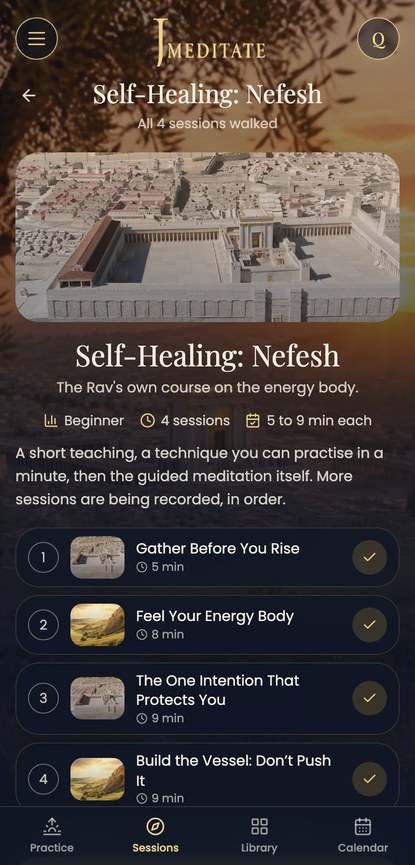
For those who want a path and not only a single meditation, there are Guided Sessions: a structured journey, taken one step at a time. The first one is "Self-Healing: Nefesh," a course on the energy body. It is built from Rabbi Shepherd's own teaching audio, with short video clips along the way. Every session has four parts: Technique, Meditation, Rest and Reflection.
The Kabbalistic Calendar
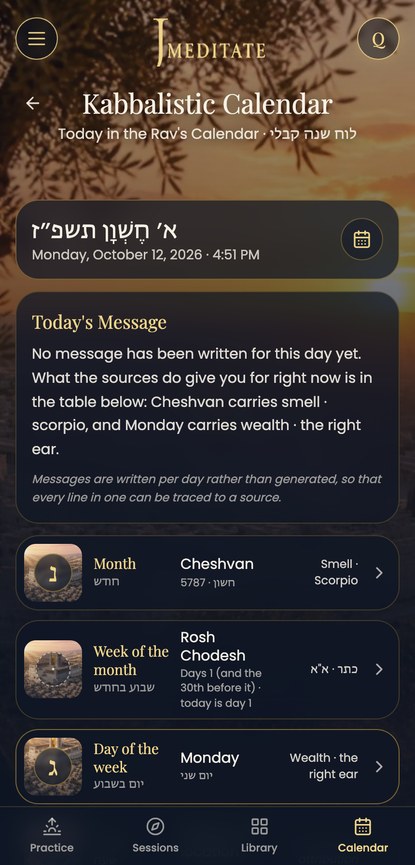
Open the calendar and you see today's Hebrew date, the month and its sense, the week and the day. Each item comes with its sources, so you can see where it was taken from.
The Self-Healing: Nefesh course
The Kabbalistic Calendar
The Library
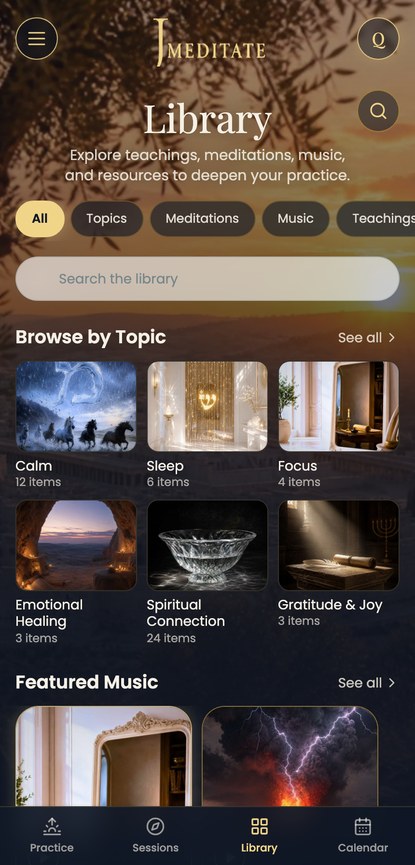
The Library gathers the teaching by topic, together with music, nature sounds and playlists. If you are looking for something specific, there is a search bar at the top.
Small things that matter
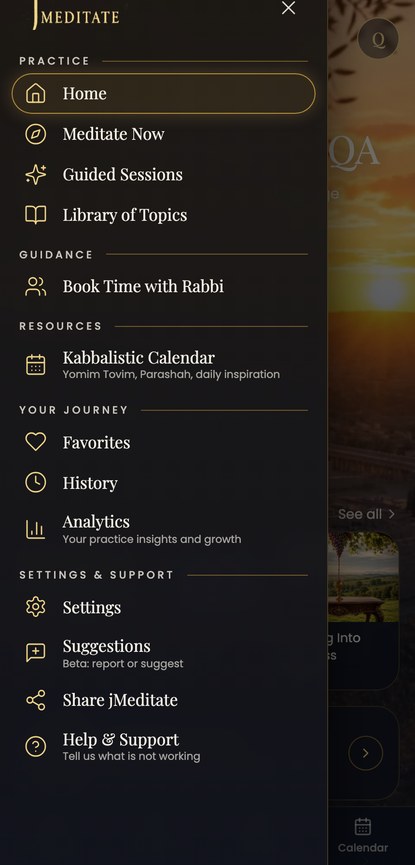
A side menu holds your Favorites, your History and Analytics of your practice. From there you can also Book Time with Rabbi, change your Settings, or send Suggestions.
On the iPhone, the audio keeps playing when the screen is locked, so you can close your eyes and put the phone down. There is a day mode and a night mode. And because this is still a beta, there is a button to report a problem or suggest an idea.
One more thing, said plainly: the app is for meditation and learning. It is not medical advice.
The Library
The side menu of jMeditate
When will it open?
Not yet. The team is still testing, fixing and recording, and we would rather open it well than open it early.
Stay with this newsletter. We will tell you here the day it opens.
From the field
The cart at the checkout
Illustration, generated image
On the day before Sukkot, a father with a full cart stood at the checkout and began to put things back. A few hundred shekels from the donations made a whole family happy for the holiday, and their joy is the merit of those who gave.
Rabbi Shepherd tells of something that happened to him on the day before Sukkot, when he went to the supermarket for the last shopping before the holiday.
The man who stood in the line ahead of him had a cart loaded full, and it was clear to Rabbi Shepherd that he was the father of a big family.
While the man was laying out his items to be rung up, he realized that he had taken too much, and that he might not have a way to pay for all of it. So he began to make a selection: which things were the most urgent, which should go through first. Then Rabbi Shepherd heard him tell the cashier that that was it, it was already too much for him, and that she should take off the other things. And even of what she had already rung up, he wanted to cancel a part.
Rabbi Shepherd understood that it was not by chance that Hashem had put him behind that man in the line. He told him right away that it was fine, and that he would pay whatever was missing.
Rabbi Shepherd took what was left of your donations and gave it to the cashier. It was only a few hundred shekels. But it made a whole family happy for the holiday.
Their joy, Rabbi Shepherd says, is our merit.
Rabbi Shepherd keeps praying for those who donate. And now too, after the holidays, the yeshiva needs your help, so that it can help others.
Support this project: https://www.jgive.com/new/en/usd/collect/donation-targets/171964/amount
You are receiving this because you joined the weekly Torah newsletter of Yeshivat HaMekubalim Nefesh HaChaim, a registered nonprofit yeshiva (registered association no. 580628527) in Jerusalem.
Sources: verses and Rashi from Sefaria (Miqra according to the Masorah; Rashi, Rosenbaum and Silbermann edition). Ramban, Ibn Ezra, Rabbeinu Bachya and Genesis Rabbah from Sefaria. Meirat Einayim, Rabbi Yitzchak of Acco, main text only, checked against the printed scan.