Friday, 30 October 2026The Torah portion of Vayeira
Vayeira5787
The shape of a man and its garments
Cover: illustration, generated image
Ramban-Yad'a · Vayeira 5787
In these pages
The shape of a man and its garments
What is new in these pages
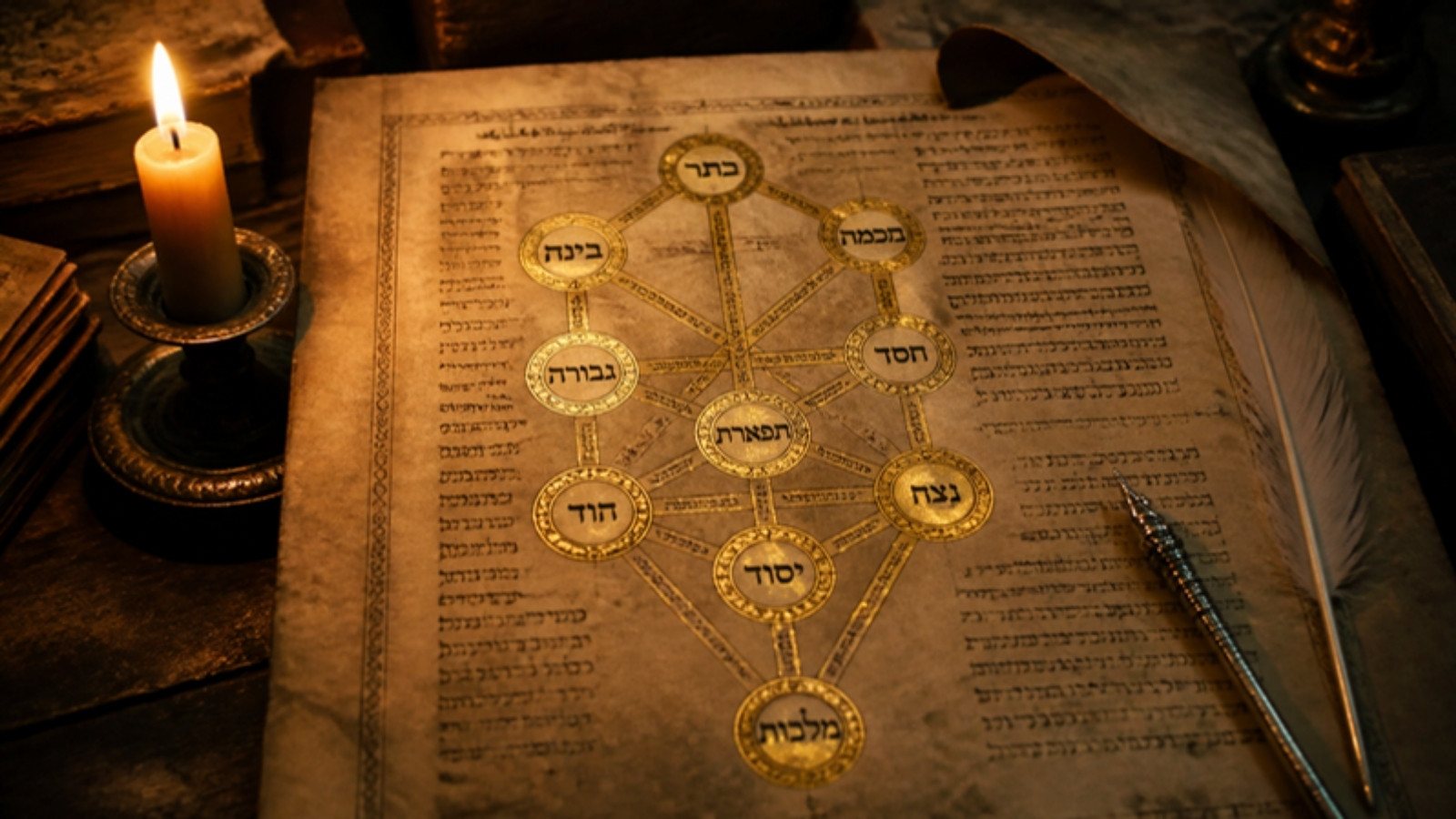
The shape of a man is not the body. It is the ten sefiros in three pillars, in a way the stamp Hashem created the world with, and a spirit that keeps the human shape can keep that root shape, not a foggy copy of the body. (Part One)
We earn the garments of the soul by act, speech, thought, intention and desire. The good ones remain in the future to come and for eternity, and souls that only have negative garments will remain naked. (Part Two)
The garment stands between the soul and this world. Through it a tzaddik such as Yaakov Avinu can, in a way, appear to very special individuals today, and they see only his lowest garment. (Part Two)
Our blessings reach more than we know. Whoever receives abundance through our deeds is tied to us by strings we cannot see. (Part Three)
Some angels support Am Yisrael. Their purpose is to escort the Shechinah. They work when Am Yisrael is united, and rise to the first source for their sustenance. (Part Four)
An offering belongs to Hashem alone. When our prayers and hopes go to Hashem, the angel rises in the light of Hashem. Therefore an angel who asks to be served or worshipped is not from holiness. (Part Five)
Holding back the judgment is one of the main things the righteous do in every generation, for us here and for the spiritual beings above. (Part Six)
He lifted up his eyes and looked, and behold, three men were standing over him. He saw them, and ran from the entrance of the tent to meet them, and bowed down to the ground.
Who were the three men? The Talmud explains that one came to bring Sarah the news of a son, one to heal Avraham and one to overturn Sodom (Bava Metzia 86b), for one angel does not carry out two missions (Genesis Rabbah 50:2). The Torah calls them men because to Avraham, whose strength was great, they appeared in the likeness of men (Genesis Rabbah 50:2).
The root shape that spirits keep
The Ramban says that when the Torah calls angels men, what is seen is a created glory called a garment, which only the pure can see. The Meirat Einayim explains that the form of a person is very dear to Hashem, and that after the resurrection and the Day of Judgment the souls of the righteous keep that form forever. Rabbi Shepherd adds that the shape of a man is first of all the ten sefiros in three pillars, in a way the stamp of all creation, and the body is its last manifestation. So a spirit that keeps the human shape can keep that root shape, not a foggy copy of the body.
There is an old dispute. The Rambam, in the Guide for the Perplexed (2:42), holds that the whole scene was a prophetic vision, seen in the mind. He says the same of Yaakov Avinu: the man who wrestled with him (Genesis 32:25) was seen only in prophecy. The Ramban asks against each claim. If the meal was a vision, Sarah never kneaded cakes and Avraham never prepared the calf, so why show it? If the wrestling was a vision, why did Yaakov limp when he was awake? If Lot's guests were a vision, how did the wicked men of Sodom, no prophets, know that guests had come to his house? Such words, the Ramban says, contradict Scripture. Elsewhere Rabbi Shepherd has taught that the angels who came to Avraham took a physical body, and for a good purpose.
The Ramban
A glory that pure eyes can see
What appears when the Torah calls angels men? The Ramban answers in a few careful words, and then he stops:
It is a created glory in the angels, which those who know call "a garment" (malbush). It can be perceived by eyes of flesh in those whose souls are pure, like the pious and the sons of the prophets. And I cannot explain.
Meirat Einayim · Rabbi Yitzchak of Acco
The form the soul keeps forever
Rabbi Yitzchak of Acco explains the Ramban's word "garment" as he received it from his teacher. The form and likeness of a person are very dear to the Holy One, blessed be He. Out of the great love of Hashem, the resurrection of the dead will be in the body and the soul themselves, as they were at first. After it comes the great Day of Judgment, when each one receives according to his deeds. Then the bodies of the righteous will be consumed, as with Chanoch and Eliyahu, and their souls will be kept in that same form forever.
Part One · Genesis 18:2
From Rabbi Shepherd's teaching
The shape of a man came first
When we think about the shape of a man, we think about a physical shape. But the shape of a man was there long before the physical body, before physical reality altogether. The whole chain of the spiritual realms comes down within that shape, which people today call the Etz Chaim (the Tree of Life): the ten sefiros (Divine attributes), organized in three pillars. The Arizal explains that this is the shape of a man. In the literature of Kabbalah the shape of a man is the ten sefiros. In a way, it is the stamp Hashem created the world with. Every part and every level of the creation has that structure, and our physical body is its manifestation in the physical realm.
It can be the original shape, the root of that shape before it was manifested in the physical realm.
Rabbi Yaakov Avraham Shepherd
Spirits are not foggy figures
The resurrection of the dead begins with a return to the physical realm, but at a certain point we will leave the physical realm, and the spiritual being will have that shape. When we imagine spirits, positive or negative, or when people draw them, we are always limited by our perception to the physical shape. So we think of a spirit as the physical shape without a physical body, a kind of foggy figure. That is a very limited perception. Once we know that the shape of a man is first of all the ten sefiros, we can understand it differently. Keeping the human shape does not mean the shape we know, which is its last manifestation in the physical realm. It can be the original shape, the root of that shape before it was manifested in the physical realm.
02
Part Two
The Garments the Soul Earns
Genesis 18:2, the opening words
Illustration, generated image
The verse · Genesis 18:2, the opening words
וַיִּשָּׂא עֵינָיו וַיַּרְא
(Genesis 18:2)
He lifted up his eyes and looked.
Why does the verse say "he saw" twice? Rashi explains that the first time it means seeing with the eyes, and the second time it means understanding: Avraham saw that the men stood still in one place, and understood that they did not want to trouble him (Rashi on Genesis 18:2).
What the eyes see is the garment
The Meirat Einayim writes that when Hashem sends the soul of a righteous person on a mission, it is clothed in a garment of air in the form of the body, seen only by the pure of soul, and that some souls are never left bare, like the showbread. Rabbi Shepherd adds that we earn the garments of our soul by act, speech, thought, intention and desire, and a soul without these garments is naked. The garment is the intermediary between the soul and this world. Through it a tzaddik such as Yaakov Avinu can, in a way, appear to very special individuals today, and what they see is only his lowest garment.
Meirat Einayim · Rabbi Yitzchak of Acco
Souls dressed in a garment of air
When the righteous have passed away and Hashem wants to send their souls on a mission to people, the Meirat Einayim writes, the souls are clothed in a garment made in the form of the body, a garment of air. When the mission is done they take it off again. They are seen only by the pure of soul, whose bodies are clean of every stain of sin, so that nothing blocks the sight of that garment. As long as the souls wear it, they gain merit and bring merit to people, and kindness and mercy come down on this world through them.
Never bare, like the showbread
There are righteous ones so dear to Hashem, the Meirat Einayim writes, that their souls are never left bare even for a moment. He compares these souls to the table of the showbread in the Beis Mikdash, which was never without bread. As he describes it, two Kohanim (priests) stood facing each other, one taking out the old bread while the other set down the new. So it is with these souls. This, he writes, is what the Sages said of the soul of Yaakov Avinu: "and this one hovers over him all the day." He puts it in one line:
(Meirat Einayim on Genesis 18:1, Rabbi Yitzchak of Acco)
The vowels were added by the editor; they have not been checked and do not appear in the source. If you have a correction, we would be glad to receive it at join.mekobalim.org.
The soul has scarcely left the body of flesh before it is clothed in a body of air.
Part Two · Genesis 18:2, the opening words
From Rabbi Shepherd's teaching
The garments we sew for the soul
There is the essence of a being, and there is its garment. In the physical realm we have our body, and we cover it with clothes. In the spiritual realm we have our soul, and we gain physical garments for the soul according to our actions, speech, thought, intention and desire. When we do good things, we acquire good garments for our soul, and those good garments will remain in the future to come and for eternity. Every negative garment, which comes from negative behavior, speech and thoughts, will be dissolved when all the evil is gone from the creation in the future to come. Then souls that unfortunately only have negative garments, if they still have existence, will remain naked.
Naked in the world of truth
This is not only in the future to come. Even now the souls (Neshamah) of the wicked, which in truth are spirits (ruchin) and not the level of a soul (Narnachiy, [Nefesh, Ruach, Neshamah, Chayah, Yechidah], the spiritual levels that make up a being), are called in the Zohar gufin artilain (naked bodies) in the world of truth. They have no mitzvot and no good deeds, and so they are naked. But Hashem has mercy on all of us, even on those wicked spirits, and He lends them a kind of simple garment so that they will not be embarrassed. If you want to learn more about this, I invite you to my course, The Master of Exorcisms. With the help of Hashem, Hashem will help us gain good, positive garments in this world and in the world to come.
All we can see is the lowest level of the garment of that being.
Rabbi Yaakov Avraham Shepherd
Yaakov Avinu and his garment
We see here that the garment is an intermediary between the soul and this world. Our physical body is also a garment of the soul, an intermediary that gives the soul the possibility to act within this world. But here in the Meirat Einayim we see that even without a physical body, the soul has another level of garment, an intermediary between the soul and the physical body. Take Yaakov Avinu. In our days, as far as we know, he has no physical body that he can act with. But because his soul has that level of garment, he has, in a way, some possibility to make a difference and to appear in this world to very special individuals.
Only the garment is seen
Some very special individuals are able to see those who have no physical body in this world at present. What they see is not the essence. They see only the garment, and they think that what they see is the person himself. But the soul of a human being, and certainly the soul of the tzaddikim (the righteous), is so much higher and more profound that no one can see it. All we can see is the lowest level of the garment of that being.
03
Part Three
Our Blessings Reach More Than We Know
Genesis 18:2, the next words
Illustration, generated image
The verse · Genesis 18:2, the next words
וַיָּרׇץ לִקְרָאתָם מִפֶּתַח הָאֹהֶל
(Genesis 18:2)
And he ran from the entrance of the tent to meet them.
Although the men knew Avraham would come out to meet them, Rashi explains, they stood where they were out of respect for him, so he went ahead and ran toward them (Rashi on Genesis 18:2).
Where a blessing to Hashem goes
The Meirat Einayim brings a tradition from his teacher: Chanoch was a cobbler who blessed Hashem with every hole he pierced in the leather and this drew blessing to Matat', until "he (Chanoch) was no more, for Elokim took him." Rabbi Shepherd draws a principle from it. Chanoch's intention was to bless Hashem alone, yet Hashem brought the blessing to the angel, and a strong bond grew between them. In the same way, whoever receives abundance from Hashem through our blessings, prayers and good deeds, a person, a soul or an angel, is tied to us by strings we cannot see.
Meirat Einayim · Rabbi Yitzchak of Acco
Chanoch, the shoemaker who blessed
Rabbi Yitzchak of Acco records a question he put to his teacher, Rabbi Yehudah HaDarshan Ashkenazi: what was it about Chanoch that made him worthy of all this (to be taken by Elokim and called Matat'), since Eliyahu's case is known? His teacher answered with a tradition he had received. In the tradition, Chanoch was a cobbler who blessed Hashem with every hole he pierced in the leather. He blessed with a whole heart and complete intention, and he drew the blessing to Matat', the emanated one. He never forgot to bless, not even for one hole, until out of great love "he (Chanoch) was no more, for Elokim took him" (Genesis 5:24). So he merited to be called Matat', whose rank is very great.
Part Three · Genesis 18:2, the next words
From Rabbi Shepherd's teaching
A blessing that reached an angel
The Meirat Einayim teaches us here about the relationship between human beings and angels. He brings an interesting Midrash about Chanoch, who became the angel Matat'. Chanoch was a shoemaker, and each time he pierced the leather to make a shoe, he blessed Hashem. His intention was to bless Hashem, not the angel. Yet the blessing came to Matat': Hashem used the blessings Chanoch said in this world to bring abundance to Matat'. This made such a strong connection between Chanoch and Matat' that when Hashem decided to take Chanoch to the heavens, Hashem turned him (Chanoch) into Matat', or merged him with Matat'.
We cannot see those strings of attachment, but they are there.
Rabbi Yaakov Avraham Shepherd
The donor and the poor man
Let me put this in more physical terms. Someone in the States sends charity every month through one of the charity organizations, Yeshivat HaMekubalim Nefesh HaChaim or a different organization, and the money reaches a certain poor man in Israel. Over time the poor man begins to feel appreciation and gratitude toward the person who supports him, until one day the donor visits Israel, and they meet and celebrate together.
Strings we cannot see
We do not know what Hashem does with our blessings, our prayers and the abundance that our Torah learning and good deeds generate. It can reach people in this world, souls in the upper worlds that have no physical body, or angels. God forbid, it can also reach the negative side, but I do not like to speak about that. Every part of the creation that receives abundance from Hashem because of our actions, speech, thoughts, intentions and desires is related to us in a higher dimension. We cannot see those strings of attachment, but they are there. When we work on ourselves to purify our actions, thoughts, speech and desires, it makes a huge difference to our network in the higher realms.
And he said: My lords, if I have found favor in your eyes, please do not pass by your servant.
Is the word for "my lords" a holy Name, or an ordinary word of respect? The Talmud records both views (Shevuot 35b). On the holy reading, Rashi explains, Avraham was asking the Holy One, blessed be He, to wait for him while he ran and brought in the guests (Rashi on Genesis 18:3).
The angels of the Shechinah and our unity
The Ramban says that Avraham called the visitors by the name of their Master, because he knew they were angels on high. The Meirat Einayim explains that this is the name of the Shechinah: said toward the Shechinah it is holy, and toward the angels it is profane. He also teaches that through the right intention these angels rise up to the First Cause. Rabbi Shepherd adds that these are angels whose purpose is to escort the Shechinah, the gathering of all Am Yisrael, and so they support Am Yisrael. Their support works when Am Yisrael is united, and then they rise to the first source and receive new sustenance.
The Ramban
By the name of their Master
The Ramban notes that the books write the word with a kamatz, the vowel that marks it as the holy Name and not a plain word of respect. Avraham called the three visitors by the name of their Master, he explains, because he recognized that they were angels on high, just as angels are called elohim and eilim. That recognition is also why Avraham bowed down to them to the ground.
Meirat Einayim · Rabbi Yitzchak of Acco
Holy toward the Shechinah
Rabbi Yitzchak of Acco explains "by the name of their Master" as the name of the Shechinah, whose Name begins with Alef Dalet. Do not be surprised, he writes, that Avraham called angels by the name of the Shechinah, for we find that angels are called elohim after the Shechinah. Then he concludes. The same word can be either one, depending on where the speaker's intention is directed:
(Meirat Einayim on Genesis 18:3, Rabbi Yitzchak of Acco)
The vowels were added by the editor; they have not been checked and do not appear in the source. If you have a correction, we would be glad to receive it at join.mekobalim.org.
So when the intention is toward the Shechinah, it is holy; and when it is toward the angels, it is profane.
Rising up to the First Cause
The Sages say that the angels at Avraham's meal did not really eat: "each one in turn rose away" (Genesis Rabbah 48:14; see Part Five). In the same passage on 18:3, Rabbi Yitzchak of Acco explains these words. The reading that seems to him to be the Ramban's view takes "each one in turn" as the angels who are first for us and last of the ten ranks of angels. They are called Ishim (men) because they are close to people. Through the offering and the right intention of the one who brings it, they rise to the world of emanation and up to the First Cause, and receive an abundance of favor, radiance and splendor, life and blessing.
This support becomes effective specifically when there is unity among Am Yisrael.
Rabbi Yaakov Avraham Shepherd
Part Four · Genesis 18:3
From Rabbi Shepherd's teaching
Angels who escort the Shechinah
The Meirat Einayim explains something profound here. The first chiddush (new insight) I want to share from his words is that there are angels related to the Shechinah, angels whose purpose is to escort the Shechinah. We know that the Shechinah is the gathering of all the Jewish people together. So when we speak of angels that escort the Shechinah, it means that there are angels that serve as a support to Am Yisrael. This support becomes effective specifically when there is unity among Am Yisrael.
They rise when we are united
When we do the right thing, these angels, the angels that escort the Shechinah and support Am Yisrael, ascend to a higher level, to the first source, the upper source, and that is how they receive their sustenance. In other words, when Am Yisrael is united, there are special angels that are able to ascend to a higher level and to reach new sustenance. And that brings the support that Am Yisrael needs.
He took butter and milk and the calf he had prepared, and set them before them; and he stood over them under the tree, and they ate.
The verse says that they ate. The Talmud learns from it that a person should never depart from the custom, for the angels came down and appeared to eat (Bava Metzia 86b).
A hint left for those who merit it
The Midrash says of the angels that "each one in turn rose away." The Ramban does not explain the rising away; he sends the reader to the angel who came to Manoach. The Meirat Einayim opens the hint. The angel told Manoach to bring his offering to Hashem, and went up in the flame of the altar, and Avraham's meal rose away in the same way, as an offering. Rabbi Shepherd adds the principle: an offering, a prayer and a hope belong to Hashem alone. Then the angel is elevated in the light of Hashem. Therefore an angel who asks to be served or worshipped is not from holiness.
The Ramban
The Ramban points to Manoach
The Midrash asks whether angels eat, and answers: "each one in turn rose away" (Genesis Rabbah 48:14). The Ramban quotes these words and does not explain what this rising away was. Instead he points the reader to the angel who came to Manoach, the father of Shimshon. And he adds a condition: the reader will understand it only if he merits it, if he is worthy to reach it. In his words:
And the matter of the rising away, you will understand from the account of Manoach, if you merit it.
Meirat Einayim · Rabbi Yitzchak of Acco
The angel who rose in the flame
Rabbi Yitzchak of Acco tells the story of Manoach. Manoach wanted to detain the angel and prepare a meal for him. The angel said to him, "If you detain me, I will not eat of your bread," and told him to make a burnt offering and offer it to Hashem instead (Judges 13:16). That is, the angel was saying: I am not fit to receive an offering for myself. But if Manoach brought an offering to Hashem, the angel would rise in the light above and be joined to it, and his strength would grow. Manoach did so, and as the flame went up from the altar, the angel of Hashem went up in the flame (Judges 13:20).
Avraham's meal was an offering
Since Avraham recognized that his guests were angels on high, as his calling them by the holy Name and bowing down to them shows, the Meirat Einayim writes, his intention was not to feed them, for he knew that angels do not eat. His intention was only for the Unique Name of Hashem, that it be blessed, and to bring down an abundance of blessing upon them. The food rose away as an offering rises from the altar, and through it added Ruach HaKodesh (added spiritual abundance) came upon the angels. In his words:
(Meirat Einayim on Genesis 18:1, Rabbi Yitzchak of Acco)
The vowels were added by the editor; they have not been checked and do not appear in the source. If you have a correction, we would be glad to receive it at join.mekobalim.org.
And this is the rising away: as if he were bringing an offering on the altar, which rises away, portion by portion, in fire toward the heavens.
The angels themselves direct us to dedicate our efforts and our offering only to Hashem.
Rabbi Yaakov Avraham Shepherd
Part Five · Genesis 18:8
From Rabbi Shepherd's teaching
Only to Hashem Himself
There is a very important principle here that we always have to remember: an offering must be only to Hashem Himself. When someone brings an offering to any other part of the creation, even to holy angels, it is considered idol worship. That is the message the angel gave Manoach, and it is a message for us too. Our prayers, our intentions, our hopes and our trust must be only to Hashem Himself.
The sign of a holy angel
When our offering goes only to Hashem, the angel gains. The angel is elevated in the light of Hashem, because human beings are doing the right thing and dedicating their intention and their offering to Hashem. But when human beings do wrong and bring offerings to other entities, even to holy angels, those angels are punished for it by Hashem. So the angels themselves do not want to be worshipped. The angels themselves direct us to dedicate our efforts and our offering only to Hashem. This is the sign that an angel is holy. If there is an angel who asks and persuades people to serve him, and in fact leads them astray into idol worship, it is not in holiness; it is from the Sitra Achra.
And Avraham drew near and said: Will You indeed sweep away the righteous with the wicked?
Avraham "drew near," and Rashi notes that he came before Hashem in three ways at once: "to speak hard words, to appease, and to pray" (Rashi on Genesis 18:23).
Anger, mercy and the work of the righteous
The Ramban reads Avraham's word af as anger: the anger of Hashem is His attribute of judgment, and Avraham feared it would sweep away the righteous with the wicked. The Meirat Einayim reads the anger as the Atarah, and shows that the Name of mercy was the one speaking with Avraham. Rabbi Shepherd reads the Meirat Einayim as saying that Avraham thought the judgment came from the Atarah, while it came from Tiferet. And he adds that holding back the judgments, as Avraham sought to do here, is a big part of what the righteous of every generation are busy with, for us and for the spiritual beings in the upper worlds.
The Ramban
The anger that sweeps away
The Hebrew word af in Avraham's question can mean "indeed," and it can mean "anger." The Ramban reads it as anger. Avraham thought that the attribute of judgment was about to sweep away the righteous together with the wicked, and he did not know that Hashem's thoughts toward the cities were thoughts of mercy. The Ramban sums up the word in a single line:
The anger of the Holy One, blessed be He, is His attribute of judgment.
Meirat Einayim · Rabbi Yitzchak of Acco
Anger, the crown and the King of judgment
Rabbi Yitzchak of Acco reads several of the Ramban's words as hints. The word af, anger, alludes to the Atarah, the attribute of judgment. In one of his readings, "the King of judgment" alludes to Tiferet. Judgment usually belongs to the Atarah. Do not let it trouble you that Tiferet is called "the King of judgment," he writes: when you reach the Torah portion of Haazinu you will understand. Avraham thought that the Holy One, blessed be He, would destroy everyone in His anger, so he spoke with "the honored Name," which alludes to the Atarah. But the proof that Hashem meant to come upon them only with mercy is this: the Name of mercy was the one speaking with Avraham.
Part Six · Genesis 18:23
From Rabbi Shepherd's teaching
The Atarah, or Tiferet?
It seems that the Meirat Einayim understands that Avraham made a mistake here. Avraham thought that the judgment Hashem was about to bring on Sodom and Gomorrah must come from the Atarah, which is the Malchus. The Meirat Einayim says no: it came from Tiferet. Generally it is true that judgment relates more to the Atarah, to the Malchus. But Tiferet can also be within the attribute of judgment, as we see in the words HaMelech HaMishpat, "the King of judgment." The King refers to Tiferet, the masculine, and still it has the attribute of judgment, Mishpat.
We need to understand that this is a big part of what the righteous people of every generation are busy with.
Rabbi Yaakov Avraham Shepherd
The work of the righteous in every generation
In any case, the purpose of Avraham here was to hold back the judgment. We need to understand that this is a big part of what the righteous people of every generation are busy with. Holding back the judgments is one of the main things the righteous do, so that we, the people here in this world, will not suffer from the judgment. And it is not only for us. It is also for the spiritual beings in the upper worlds, so that they too will not suffer from the judgment.
I want to say this to you plainly. Supporting this yeshiva is an enormous merit. Our supporters can merit many yeshuot (salvations). Here is what we do for the people who help us, our partners on this path.
Whoever gives their tithes to the yeshiva merits that we pray for them on an ongoing basis, at holy places in the Land of Israel. Our emissaries go out at least once a month, each time to a different place. We always mention the names of our supporters. On important hilulot and at special times of segulah, we do everything we can for our partners. Whoever chooses a standing order sends their name with the emissaries every time, not just once.
Many great rabbis have recommended supporting this project, among them Rabbi Mordechai Goldstein zt"l, Rosh Yeshiva Rabbi Yitzchak Goldstein shlita, the Yanuka, Rabbi Shlomo Yehuda Be'eri shlita, the Admor Rabbi Yosef Berger shlita, the Admor Rabbi Tobias shlita, Rabbi David Sackton, and many others. Rabbi Sackton put it this way: "If you're a donor, there could not be a better thing to support."
Your gift sustains the Beit Midrash at the Tomb of King David, the rabbis who teach in it, the printing of books and siddurim, and the emissaries. This work is great and important, and it helps many people all over the world.
You are receiving this because you joined the weekly Torah newsletter of Yeshivat HaMekubalim Nefesh HaChaim, a registered nonprofit yeshiva (registered association no. 580628527) in Jerusalem.
Sources: verses and Rashi from Sefaria (Miqra according to the Masorah; Rashi, Rosenbaum and Silbermann edition). Ramban from Sefaria (Vocalized Edition). Talmud from Sefaria (William Davidson Edition); Genesis Rabbah from Sefaria (Midrash Rabbah). Meirat Einayim, Rabbi Yitzchak of Acco, main text only, read from the printed scan; abbreviations written out.
A note on the vowels: the Meirat Einayim is printed without vowels. The vowels on its quotations here were added by us; they are not in the source and have not been checked by an editor. If you have a correction, we will be glad to receive it.