The Heart Is a Sanctuary
A Kabbalistic breath practice, and what the breath carries
Most breathing exercises stop at the lungs. Notice the inhale, notice the exhale, come back when the mind wanders. It calms you down, and that is worth something. The Kabbalah asks a different question about the same breath:
What is in it?
Start with the word. In Hebrew, air is avir. Take the word apart and you get Ohr Yud, the light of the letter Yud. Yud is the first letter of the Name Havayah, the four-letter Name of Hashem.
So the air you just pulled in through your nose is, in the language of the Holy Tongue, the primal light of His Name.
You are not only taking in oxygen. You are taking in light.
There is a second word hiding next to it. Breath is neshimah. Soul is neshamah. Almost the same letters. In lashon hakodesh the names of things reveal their root, and this is not a coincidence.
Every breath is a meeting between the body and the soul.
Three organs, three levels of soul
The Arizal maps the soul onto the body in a simple way. Nefesh, the basic life force, sits in the liver and the limbs below the diaphragm. Ruach, the second level, flows in the chest, the heart, the lungs and the hands. Neshamah, the third, flows in the skull and runs the mind.
Look at where the heart lands on that map. It is in the middle. Above it is thought. Below it is the gut, instinct, survival. When your head says one thing and your gut says another, it is the heart that has to settle it.
And Ruach literally means wind. It is the level of soul that comes and goes, like weather, like feeling. It is also the level tied to breathing.
In one of my meditation classes I put it this way:
“While we are breathing, like the air comes in, wind, Ruach, comes in, the Neshama sustains the Nefesh through the Ruach.”
The breath is the channel by which the higher soul feeds the lower one. It passes through the heart on the way.
Why “sanctuary”
There is an old custom to imagine yourself standing inside the Beit HaMikdash before the Amidah. Not as a memory of history. As something present.
The Kabbalah teaches that the Temple in Jerusalem was the gate through which the prayer of Israel rose, and that corresponding to it there is a sanctuary in the heart: a pillar connecting the physical heart to the Beit HaMikdash shel maalah, the Heavenly Sanctuary, which was never destroyed and never will be.
The body around that heart is not an obstacle. In Judaism the body is a mishkan, a dwelling place. Hashem created it, Hashem sustains it, and the soul uses it for His service.
A Jewish body that serves Hashem becomes a miniature Beit HaMikdash.
The Recanati, commenting on Bereishit, brings the Sefer HaBahir on the phrase “to the heart of the heavens”: in that heart are comprised the thirty-two paths, the wonders of Chochmah.
Thirty-two is lamed-bet, which spells lev, heart. Ten sefirot and twenty-two letters, folded into the organ beating under your ribs right now.
So the heart is not the soft thing greeting cards make of it. It is a receiving station between mind and body with a direct line upward. That is a sanctuary.
The practice: light down, light back
The meditation is built on two movements the Arizal describes. Ohr Yashar is the direct light descending. Ohr Chozer is the returning light ascending.
The breath maps onto them exactly.
Sit comfortably and close your eyes. The kabbalists taught that closing the eyes is the first step of hitbonenut, inner contemplation, because the senses pull the soul outward through sight.
If you can, let out one deep sigh first, an anachah. In Kabbalah the sigh breaks the azut, the thick density of the body, and makes room for the soul.
Inhale — Ohr Yashar
Then inhale, slowly, through the nose.
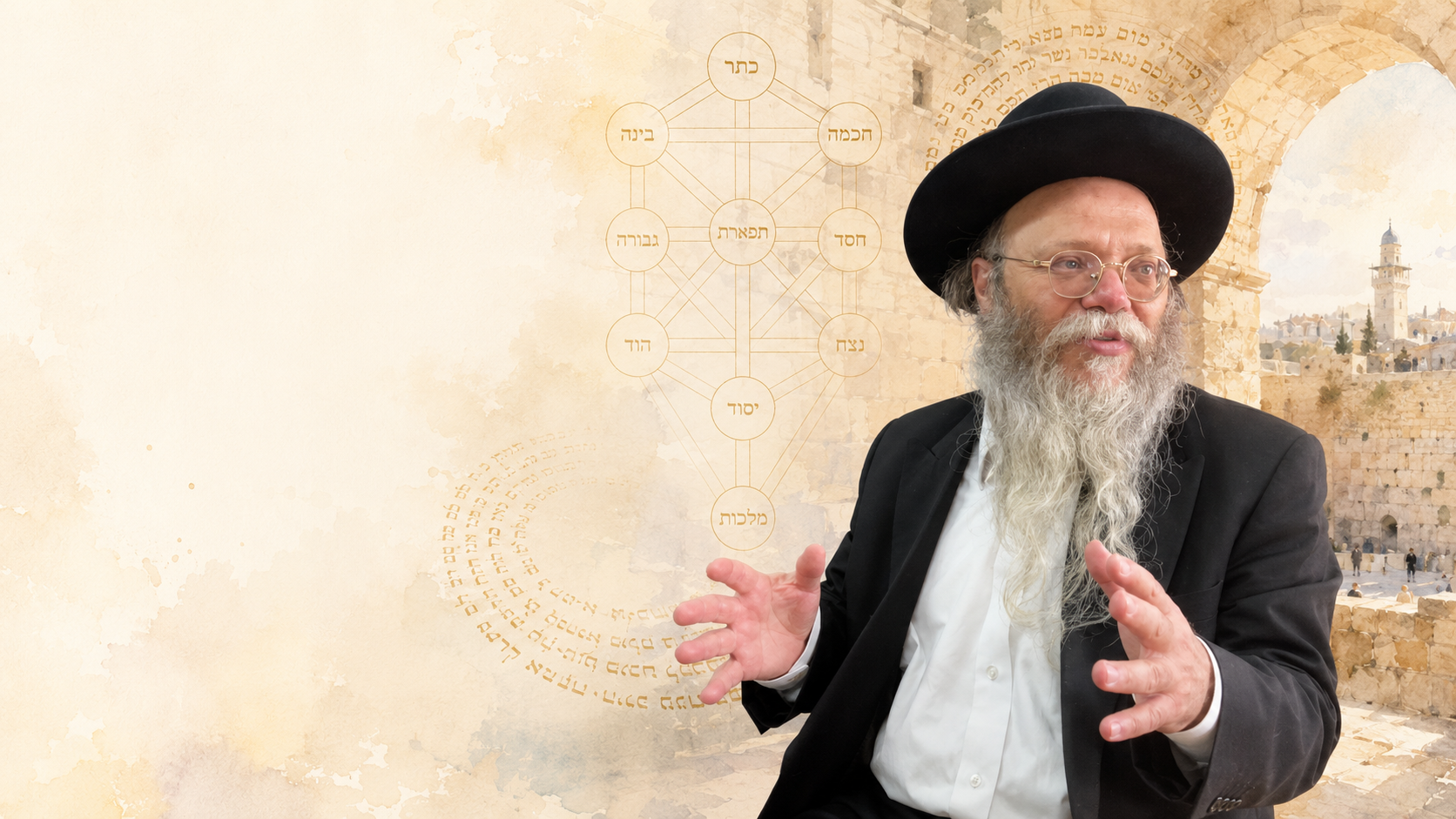
As you do, picture light descending from a point above the head: Keter, quiet and infinite. It enters the right side of the head, Chochmah, and the left side, Binah.
From there it comes down the neck, the spine, the chest, the arms, the belly, all the way to the soles of the feet.
Keter to Malchut, through the whole body, like a quiet waterfall of light.
Exhale — Ohr Chozer
Now exhale.
Picture the opposite. The light rises from the soles, through the belly, through the chest, through the head, back to Keter.
You are returning the light to its Owner, like a wave rising back to shore.
If you want words, the stress-reset version of this practice uses two short ones.
On the inhale, silently:
“Hashem Yitbarach, Your light is entering me.”
On the exhale:
“Whatever is not from You, take it. I return it.”
Tension, noise, worry go out on that breath.
Do several cycles, without rushing and without effort. Then stop and feel the body. Not as a device to fix, and not as something to bypass. As a vessel the light just moved through.
Job says it: mi’besari echezeh Eloha, from my flesh I see God.
According to the Arizal your soul always sees Him and always receives from Him; it is the body that usually does not know.
This is the moment the body begins to know.
The air of Gan Eden
For me, this whole subject connects strongly to a passage at the beginning of the Ramchal’s Adir Bamarom, a meditation I would call an elevation of the soul to Gan Eden.
The way in, as I read it, is that a person needs to draw to himself the air of Gan Eden. That air is a different kind of surrounding, a certain surrounding light, the way we here are surrounded by ordinary air.
The breath you take at your desk and the breath the soul takes in Gan Eden are the same direction, only further away.
So this is not a trick for calming down. It is practice in the same motion, a few steps earlier.
Making it yours
You do not need a quiet room. On the road, at work, walking into a store, one conscious breath with the thought “Ohr Yud enters me” is enough to connect.
It is a lifelong practice:
Ein od milvado, there is nothing besides Him, through the lungs.
And if you feel nothing the first few times, my advice is the same one I give for every meditation:
Keep meditating, don’t give up, just keep at it.
The sanctuary within you is always open. It only needs you to walk in.