
‘When Avraham looked up, his eye fell upon a ram, caught in the thicket by its horns. So Avraham went and took the ram and offered it up as an elevation offering in place of his son.’
– Bereishis (Genesis) 22:13
During the Jewish month of Elul, in the lead up to Rosh Hashanah a.k.a. the Day of Judgment, a shofar (ram’s horn) is blown every day except Shabbos and the day before Rosh Hashanah. Its soulful, piercing sound is a call to look inward and repent for the sins of the past year. It is blown with confidence that in the merit of Avraham’s ultimate sacrifice, the severities of judgment will be lightened and sweetened.
Hidden within the letters of the word “shofar” lies the mystery of this powerful spiritual tool that sweetens the judgment.
The deeper meaning of Hebrew characters
The Kabbalah provides the 22 letters of the Hebrew alphabet a deeper meaning. We can actually say that there are 27 Hebrew letters since five have sofit (final) forms when they are positioned at the end of a word. The sofit forms of the letters mem, chaf, tzadik, nun and pei are shaped differently, resulting in 27 Hebrew characters.
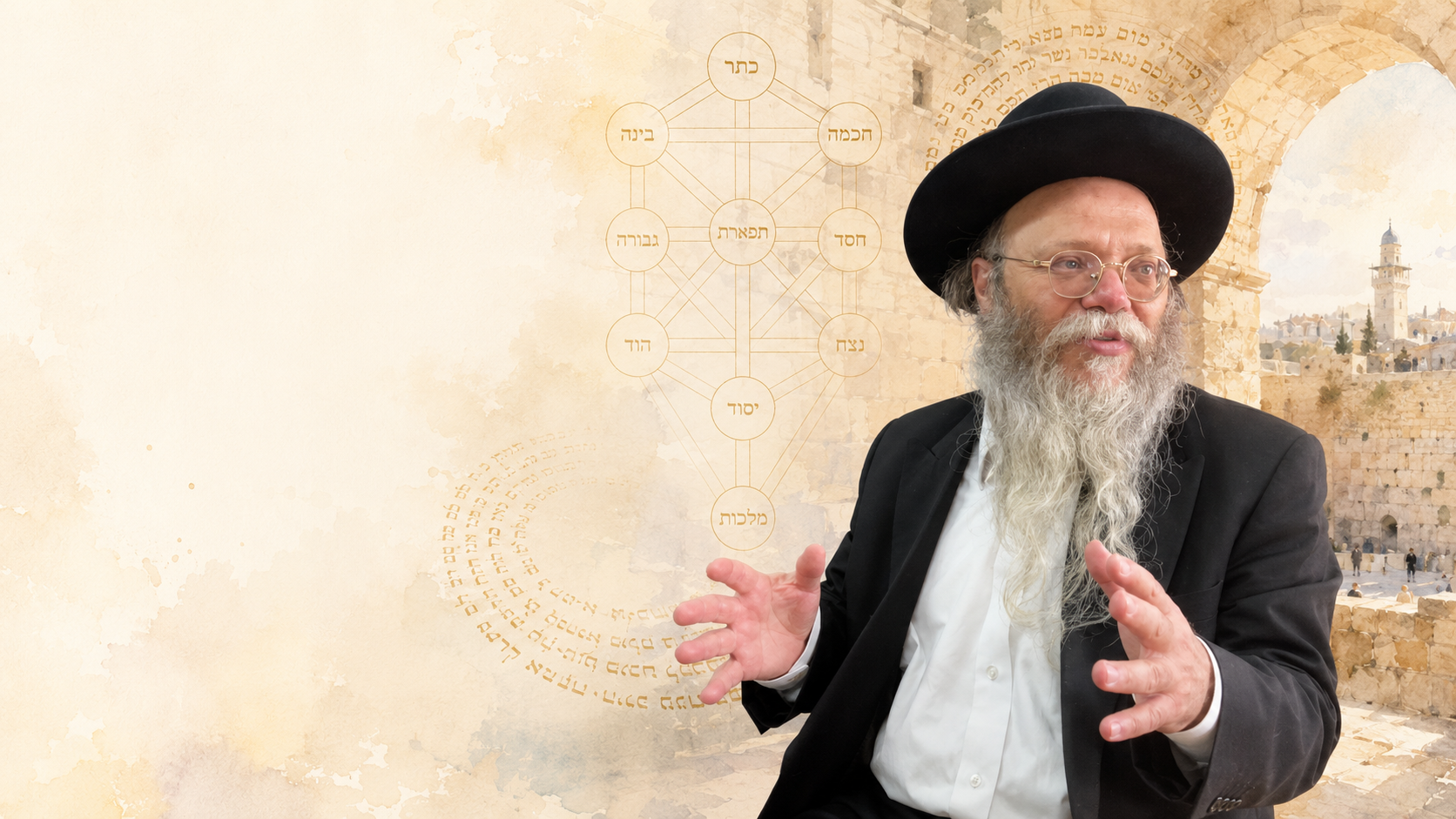
These final forms symbolize judgment since something that ends has the quality of placing a limit or restriction. Judgment and limitations are qualities of gevurah on the left pillar of the tree of life diagram. In fact, in Kabbalistic texts, these letters are known as the five Gevurot (severities/strengths).
Each Hebrew letter has a numerical value. The gematria (numerical value) of these five final letters is as follows: mem = 40, chaf = 20, tzadik = 90, nun = 50, and pei = 80. Their sum is 280 or פ״ר. In Hebrew, almost every word related in some way to division or separation carries the same root as פ״ר or 280. These letters and therefore this number is considered to have the power to break up impurity.
The gematria of the Hebrew word for bull (פר / par) is also 280. This animal essentially was domesticated to break up the soil. These same two letters, פר, are the two final letters of the word shofar. Therefore, within the word “shofar” is an aspect of the judgment.
The gematria of the shofar
The other letters of the word shofar, שו (shin-dalet), belong to a Kabbalistic concept called “320 sparks.” The number 320 is also related to the judgment. Combined with “פר”, it symbolizes all of the judgment of Creation. Still, the gematria of שו is 306. The missing 14 is found in the hand, which has 14 joints in the fingers. The hand that holds the shofar forms the 320.
So, when we are holding the shofar, we are holding the representation of all the judgments of the creation. The purpose of this powerful tool is to sweeten the judgment of Rosh Hashanah. It is important that our intention be to bring mercy to all of Creation and not just to ourselves.
The “Asher Yatzar ”, the brachah (blessing) recited after using the bathroom, acknowledges that Adam was created with chokhmah (wisdom). The Arizal teaches that the purpose of this blessing is to sweeten the judgment. In Kabbalah, chokhmah is uppermost on the right side of the Tree of Life, the pillar of kindness. Similar to Hashem blowing life into Adam, He insufflates “His” Ruach (Spirit/Breath) into us every day. And when we blow the shofar, we bring the ruach from our inner being and place it into the judgment, into the physical, in order to sweeten the judgment.
Preparing for Rosh Hashanah during Elul
For the shofar to have an actual impact, preparation is necessary during the month of Elul, which is considered the preparation ground for sweetening the judgment. This is the reason we start blowing the shofar in Elul. Elul is the motor that will give the strength to face the judgments and actually be able to sweeten them.
During Elul, we recite Psalm 27. The name of Hashem appears in this psalm in repetitions of 13, echoing the 13 Attributes of Mercy. The goal is to bring down the flow of the 13 Attributes during this month.
A very important part of preparing for Rosh Hashanah is Hatarat Nedarim (nullifying the vows). The Hatarat Nedarim we are referring to is not to remove a specific vow but to remove judgments from ourselves.
When someone would come to Rav Avichai (my Rabbi) telling him about the negative things happening to the person, he would always advise doing Hatarat Nedarim. Hatarat Nedarim can be viewed as a segulah (remedy or protection) to remove the negative aspects of our lives.
The main goal of Elul, Rosh Hashanah, the Days of Awe, and Yom Kippur is to sweeten the judgment by bringing the flow of mercy through the variety of spiritual tools available to us. The shofar, Hatarat Nedarim, meditations, etc., are tools for us to connect with the abundance of the 13 Attributes of Mercy and sweeten the judgment.
Use this knowledge to connect with Hashem, and may we all have a Chatima Tova (a good, final sealing).
Rabbi Yaakov Avraham Shepherd is the head of Yeshivas HaMekubalim Nefesh HaChaim on Mount Zion, Jerusalem, and Head Kabbalist at King David Kabbalah. He has also been teaching at Diaspora Yeshiva for over 15 years, where he has taught Chumash, Navi, Gemara, Shulchan Aruch and more, in English and Hebrew. More…