
Sealed, But Not Yet Delivered: The Zohar’s Secret of Sukkot
Most of us walk out of Yom Kippur with a quiet assumption: it’s over. The gates closed at Ne’ilah, the shofar sounded, the book was sealed. Whatever was written is written.
The Zohar says: not quite.
Three Stages, Not Two
In Parashat Pekudei (237b), the Zohar describes the judgment of these days as a process with three distinct stages, not two:
- Writing — Ketivah. On Rosh Hashanah the heavenly court sits and the decree is written.
- Sealing — Chatimah. On Yom Kippur the decree is sealed by the King.
- Delivery — on Hoshana Rabbah, the seventh day of Sukkot, the sealed slips — the Zohar calls them pitkin, decree-notes — actually leave the King’s palace and are handed to the forces appointed to carry them out.
The Zohar’s language is precise: the notes go out from the King’s house, and once they are delivered, they do not return until the judgment is executed.
Delivered — not sealed — is the point of no return.
Which means the seven days between Yom Kippur and Hoshana Rabbah are not an afterthought to the High Holidays. They are the last open window.
A sealed envelope that is still sitting in the palace can, in the King’s mercy, be called back. This is why the Rav teaches, following the Zohar, that Sukkot is not a separate holiday that happens to fall in Tishrei. It is the final act of the same drama — the week in which we surround ourselves, physically, with mitzvot: we sit inside one (the sukkah) and hold another in our hands (the lulav), sweetening whatever harshness still hangs in the air before the notes go out.
The Shade of Faith
The Zohar gives the sukkah a name: Tzila d’Mehemnuta — the Shade of Faith.
Why shade? Direct sunlight is the Kabbalah’s picture of revealed light: overwhelming, undeniable, leaving no room for doubt. A shade, by definition, veils. You cannot see the sun through the schach; you see slivers and shadow.
That is exactly the world we live in. This world, Olam HaZeh, is a shaded place — Divine providence runs through it constantly, but hidden underneath natural law, circumstance, and personal trial.
When you leave your solid house and sit for a week under a roof of cut branches, you are rehearsing the deepest skill of the spiritual life: staying certain of Hashem’s embrace precisely where you cannot see it.
The Rav teaches that the schach functions as an ohr makif — an encompassing light — a canopy of faith you physically enter.
The sukkah does not argue you into emunah. It surrounds you with it.
And notice the timing. Immediately after the days of judgment, the Torah does not send us to a fortress. It sends us to the flimsiest structure we build all year — and calls it the safest place in the world.
Seven Guests, Seven Days, Seven Powers
Into this shade of faith come guests. The Zohar teaches that each night of Sukkot, the Ushpizin Ila’in — the supernal guests — enter the sukkah: Avraham, Yitzchak, Yaakov, Moshe, Aharon, Yosef, and David.
All seven come every night, but each night one of them leads.
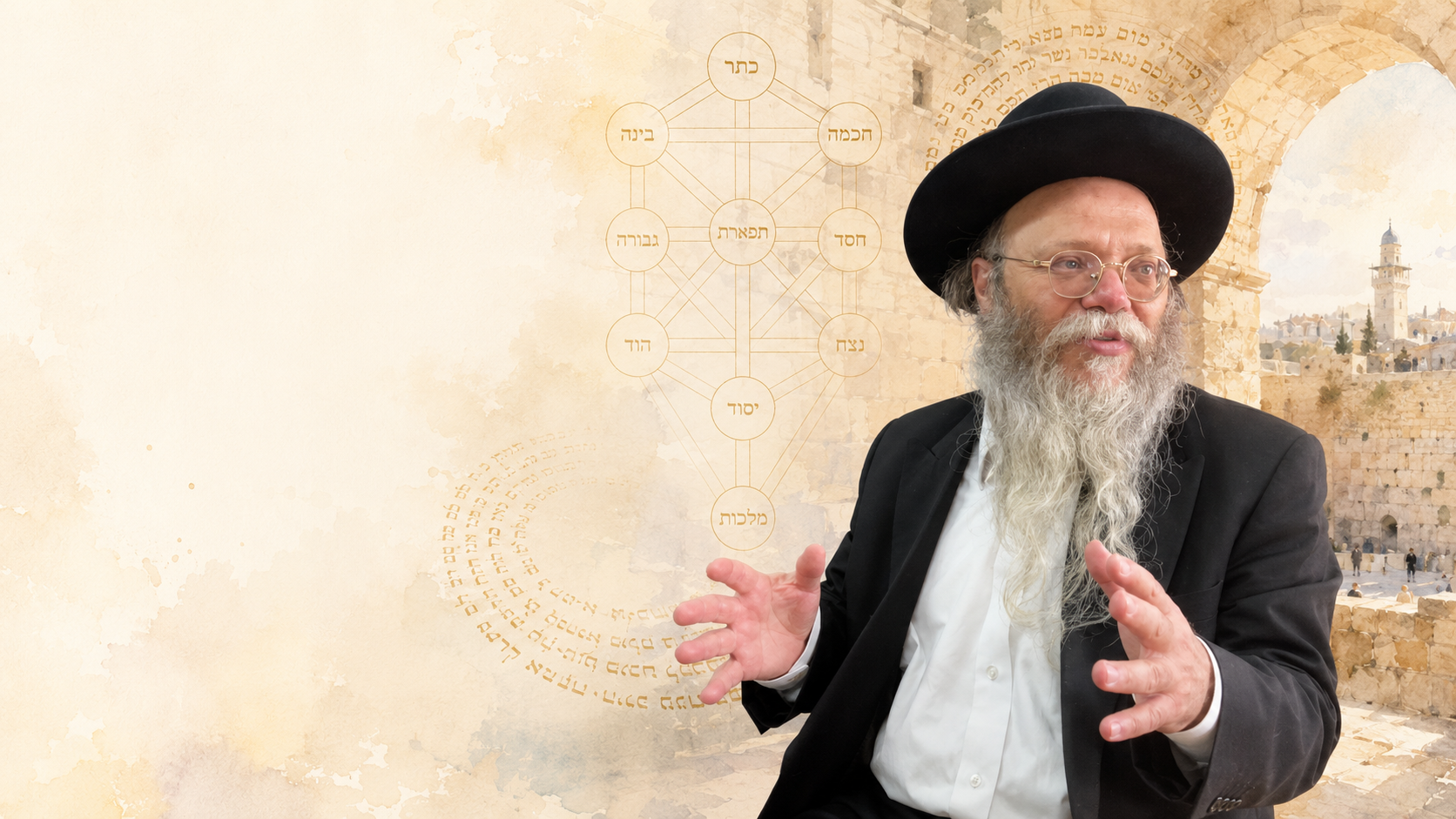
These are not visits of nostalgia. In the Kabbalah, each of these seven figures is the merkavah — the living chariot — of one of the seven lower sefiros, the seven powers through which the soul acts in the world.
The week of Sukkot is a guided tour through your own inner structure, one attribute per day:
- Day 1 — Avraham, Chesed. Lovingkindness. The work of the day: give without calculating the return. Open the hand and the door.
- Day 2 — Yitzchak, Gevurah. Strength and holy awe. The work: restraint — over anger, over appetite — binding the chaos on the altar the way Yitzchak was bound.
- Day 3 — Yaakov, Tiferes. Harmony and truth, the central pillar. The work: integrate the first two — kindness with backbone, discipline with warmth.
- Day 4 — Moshe, Netzach. Endurance. The work: persistence in your spiritual commitments when the initial inspiration is gone.
- Day 5 — Aharon, Hod. Splendor, gratitude, humility. The work: thank, concede, make peace — Aharon’s craft of loving peace and pursuing it.
- Day 6 — Yosef, Yesod. Foundation, purity. The work: guard the eyes, the speech, the covenant — become a clean channel so that blessing can actually flow through you to others.
- Day 7 — David, Malchus. Kingship, prayer, receiving. And this seventh day is Hoshana Rabbah itself — the day the notes go out. The last guest is the master of Tehillim, the king whose entire power is prayer. That is not a coincidence. It is the architecture.
The Guests Eat From the Poor Man’s Plate
One more teaching, and it is the sharpest of them all. The Zohar in Parashat Emor asks: what do supernal guests actually eat?
They have no bodies. Their portion, the Zohar answers, is the portion you give to the poor.
And the Zohar does not soften what follows. If a person sits in his beautiful sukkah, recites the invitation to the holy guests, and feasts with his family and his wealthy friends while the poor get nothing — Avraham Avinu stands up and declares:
this is a table of disgrace, not the table of Hashem.
All seven guests walk out. And into the empty seats come the forces of judgment.
The plate you set for someone who has less is not charity appended to the holiday. It is the vessel that holds the entire light of the sukkah.
A Practice for the Week
Here is a simple structure the Rav gives for making this week real.
Each night, before the meal, stand at the entrance of the sukkah and formally invite the guests, naming that night’s leader.
Then sit for two quiet minutes with that night’s attribute:
Where did Chesed flow through me today, and where did it get stuck?
Where did Gevurah protect me, and where did it turn into anger?
One honest question per night, seven nights in a row, inside a canopy of faith — that is a complete inventory of the soul, finished exactly when the verdict is dispatched.
A donation made now through the same campaign link is dedicated to the Sukkot campaign. Until the night of Hoshana Rabbah, your name stays in the Rav’s prayers. Take part in the Sukkot campaign, food for the holiday and the four species for families who cannot afford them:
https://www.jgive.com/new/en/ils/donation-targets/176166
The book may be sealed. But it is still in the palace. You have seven days, seven guests, and a shade of faith over your head.
Sources: Zohar, Parashat Pekudei 237b (the pitkin and the three stages of judgment); Zohar, Parashat Emor (the Ushpizin and the portion of the poor); Zohar on the sukkah as Tzila d’Mehemnuta; as taught in the holiday shiurim of Rav Yaakov Shepherd.